The short answer
Geographically, Ukraine is unquestionably part of Europe. For travel insurance, however, that isn't the criterion that decides whether your policy pays out. An insurer works not from a map of continents, but from a rating zone and a list of exclusions. And this is where the main misunderstanding lies: a standard policy with a "Europe" coverage zone very often does not extend to Ukraine — not because Ukraine is "not in Europe", but because it is separately excluded as a territory with an active armed conflict.
So the right question isn't "is Ukraine in Europe?" but "is Ukraine within my policy's coverage zone, and is it not knocked out by a war-risk clause?".
Why "continent" and "rating zone" are two different things
When you buy a travel policy, the word "Europe" in it is a marketing label for a rating group of countries, not a geographical concept. Each insurer decides for itself which states belong to that group. A very common pattern:
- the "Europe" zone covers EU and Schengen countries, sometimes the United Kingdom and the Balkans;
- higher-risk countries (conflict zones in particular) either fall outside every standard zone or are set out in a separate list of excluded territories.
So you can buy a "European" policy, be physically in Europe — and still have no protection at all while in Ukraine.
Where in the policy to find the truth
Check the wording of the contract itself, not the promotional blurb. Three places decide everything:
- The "Territory" / "Coverage zone" section — Ukraine should be named explicitly here, not hidden behind an abstract "Europe".
- The "Exclusions" section — look for wording about acts of war, armed conflict, terrorism and states of emergency. In a classic travel policy this is almost always a deal-breaker.
- A separate war-risk provision (war & terrorism clause) — its presence means war risks may be covered, but under specific conditions and usually for an extra premium.
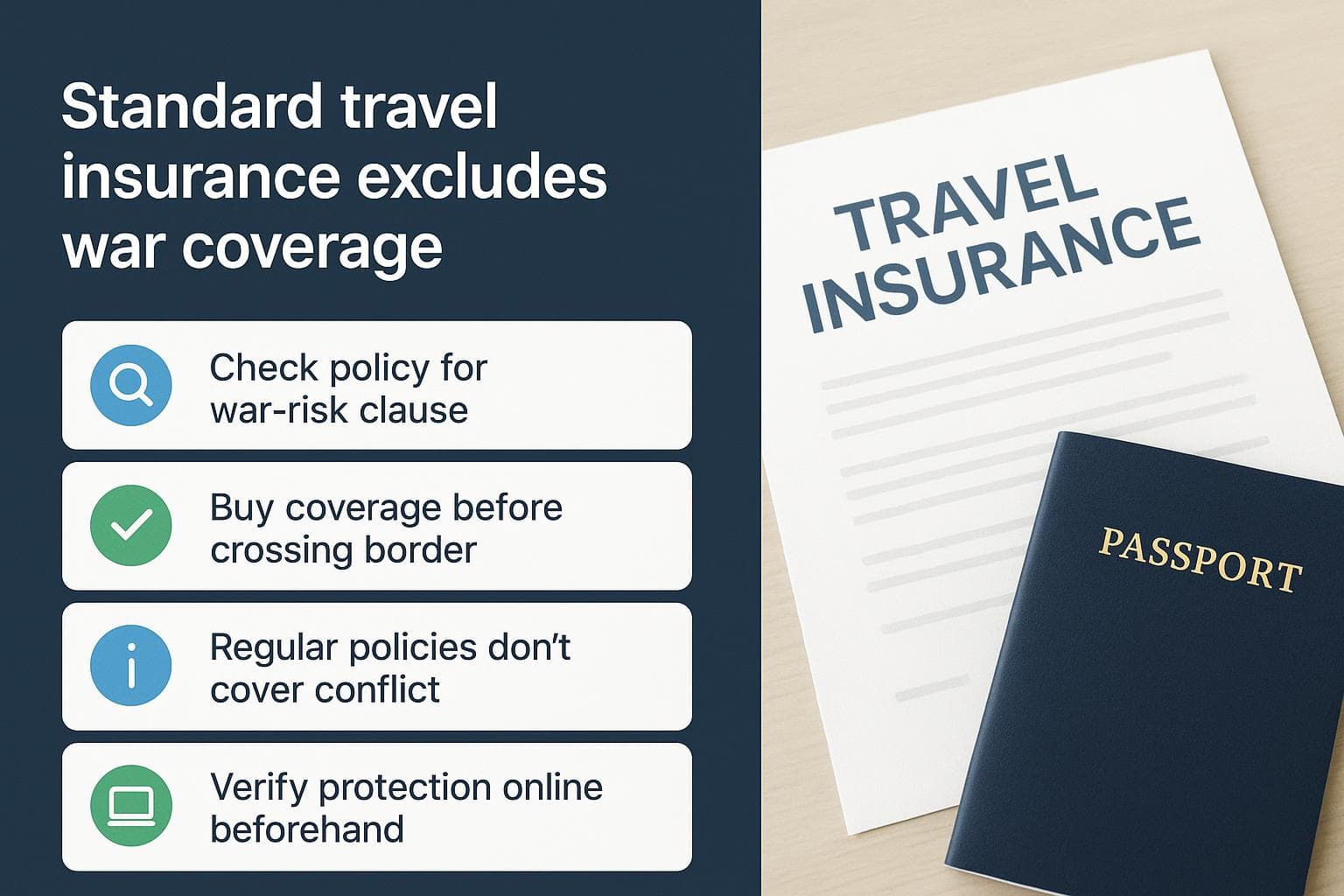
If the first two points aren't clear, or if the third is missing, assume you have no war-risk cover in Ukraine — even if the cover page says "Europe".
Why a standard "Europe" policy usually won't save you
The vast majority of mass-market travel policies contain an outright exclusion for loss caused by war or armed conflict. That's a standard market norm, not an error. As a result:
- a "Europe" policy bought for a holiday in, say, Spain is very likely invalid in Ukraine;
- even if Ukraine isn't excluded by territory, a war clause can cancel payouts for events linked to hostilities.
That is exactly why a trip to Ukraine calls for a specialist product with explicit war-risk cover, not a general-purpose European policy.
What territorial exclusions look like in a dedicated policy
A responsible insurer does not exclude entire regions — that would be inaccurate and unfair to safe areas. Instead, four categories of zones apply where cover is restricted:
- combat zones — as defined by the applicable state acts;
- temporarily occupied territories;
- a 50-kilometre buffer around both of the above;
- areas under a special-access regime.
The rest of the country normally remains within the coverage zone. That's the fundamental difference from the everyday assumption that "all of Ukraine is dangerous".
A step-by-step check before you buy
- Open the full terms and conditions, not the short summary.
- Find the word "Ukraine" in the territory section — the country itself, not "Europe".
- Read the war and terrorism exclusions.
- Make sure there is a separate war-risk cover and that it is switched on.
- Match your route against the four categories of excluded zones.
- Get a quote — only a quote confirms the actual cover for your specific dates and route.
No amount of "geographical logic" replaces a quote. Cover is confirmed only in the price calculation on the checkout page, where you see the exact terms for your trip.
Where to get official data on trip safety
Before you buy, cross-check primary sources rather than forums:
- travel advice from your own country's foreign ministry;
- official Ukrainian acts on combat-zone and occupied territories;
- current maps of areas under a special-access regime.
These sources are updated over time, so check them right before departure.
About the insurer and transparency
The product with war-risk cover is provided by an insurer regulated by the National Bank of Ukraine (licence class 18) and belonging to a group listed on an EU stock exchange and subject to the Solvency II regime. The agent arranging the policy holds USREOU code 44559356; in line with IDD requirements, disclosure of the intermediary's identity is provided to the customer before the contract is concluded.
On the market, cover like this typically starts from a few euros a day, but the exact amount depends on your dates, route and chosen options — and is shown only in your personal quote.
Bottom line
Ukraine is Europe geographically, but not automatically "Europe" in your policy. Don't rely on the name of a rating zone: read the territory of validity, the exclusions and the war-risk clause, and get your final answer from a quote. That's the only way to be sure your protection really works.