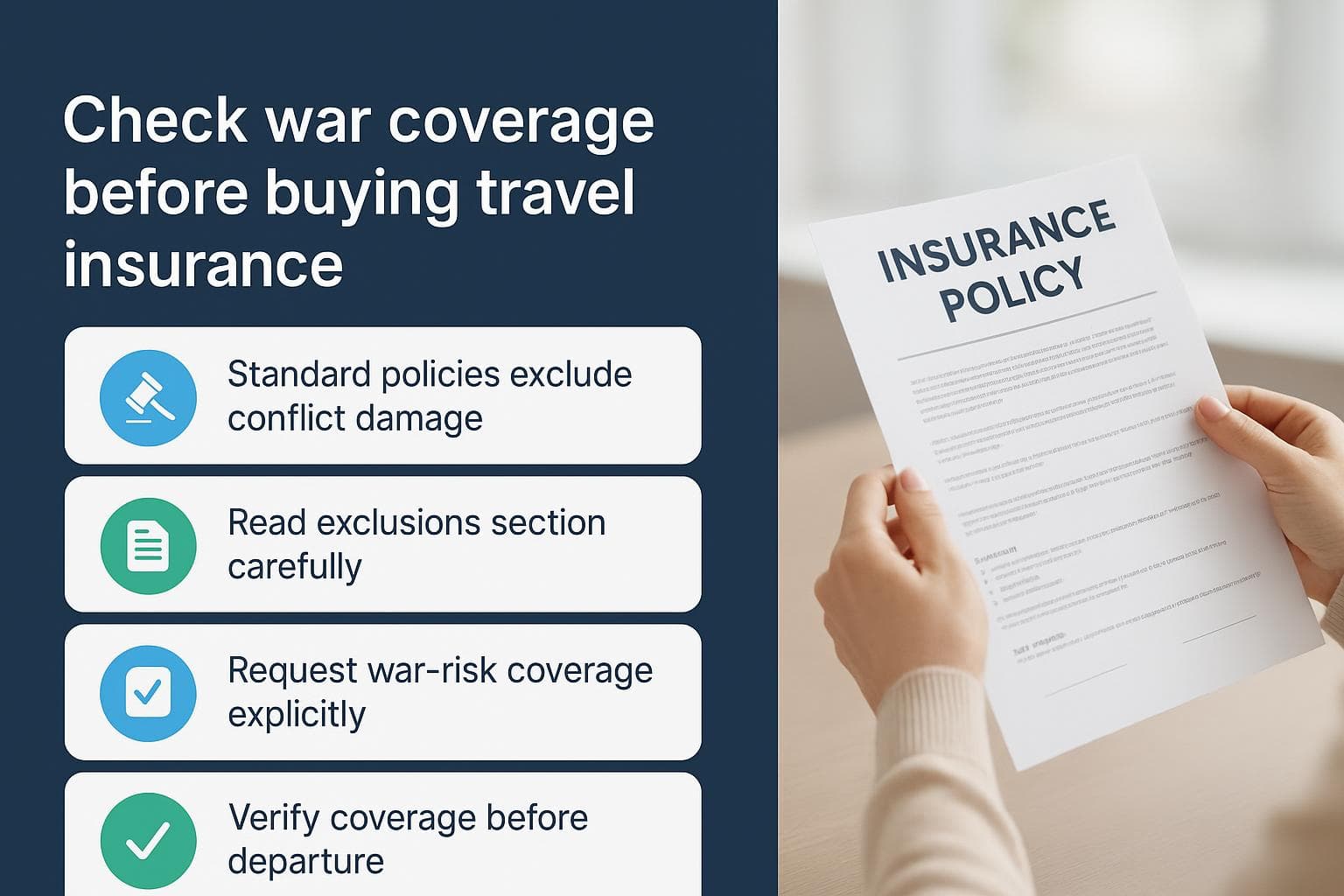
In short: does a regular travel policy cover war in Ukraine
No — the typical travel policy you buy for a holiday almost always contains an explicit exclusion for events connected to war, armed conflict, and acts of terrorism. That's standard market practice, not the quirk of one particular company. So when you arrive in Ukraine in 2026, you may technically hold "insurance" yet have no protection against the very risks that actually matter here.
The fix is simple: you need a separate product in which war-risk coverage is written directly into the terms, not buried in the exclusions. Below we explain what such a policy looks like, what to check, and where to buy it.
Why war risks are a coverage category of their own
Insurers draw a line between "peacetime" risks (sudden illness, injury, lost luggage) and risks caused by hostilities. The latter are far harder to price, so they are either excluded outright or offered as a separate extension with its own limits and territorial conditions.
For a trip to Ukraine, the key question isn't "do I have insurance at all" but "does my policy cover medical care and evacuation if the cause was an event connected to war." If the document doesn't say so, any such costs will fall on you personally.
Checklist: what to look for in a policy before you buy
Before purchasing, confirm that the document explicitly includes the following points:
- Medical expenses arising from war-related events. It must state clearly that treatment of injuries caused by hostilities is covered rather than excluded.
- Medical evacuation and repatriation. Transport to a safe region or back home is one of the most expensive scenarios, so the limit for it matters more than the headline total.
- 24/7 emergency assistance. A round-the-clock assistance service that coordinates hospitalisation and logistics in Ukrainian and English.
- Clear territorial terms. The policy should cover the areas where you'll actually be and describe the exclusions transparently (see below).
- Duration and format. Coverage for the exact dates you need, with online purchase and an electronically delivered document.
- Who the insurer and agent are. A licensed insurer and a legally registered intermediary are the basic guarantee that the policy is valid.
If every point is in place, the document does its job. If war-risk coverage or evacuation is missing, it's just an ordinary travel policy — and for Ukraine it won't do.
Territorial exclusions: four zone categories
No sound policy covers the entire territory of Ukraine without reservation, and none excludes whole oblasts either. Exclusions are defined precisely — which is why you should read the list of zones rather than "names of regions." In the product we're describing, exactly four categories of territory are excluded from coverage:
- Combat zones as defined by the relevant state acts.
- Temporarily occupied territories.
- A 50-km buffer zone around the territories in the first two points.
- Areas under a special-access regime.
Everything outside these four categories is covered. This approach gives you predictability: you can see in advance where the policy works, rather than relying on vague wording.
How much it costs
The price depends on the length of the trip, your age, and the limits you choose, so there's no fixed "price per policy." As a market benchmark, products with war-risk coverage cost a few euros per day. The exact figure for your dates is always shown on the quote page before payment, with no hidden add-ons.
How to buy a policy step by step
- Set your dates and route. Count the number of days you'll stay and the regions you plan to visit — that's the basis of the calculation.
- Open the quote page. Go to the online quote and purchase page.
- Enter the basic details. Country of citizenship, age, and travel dates are enough for an instant quote.
- Check the coverage. Make sure the terms include war risks, medical evacuation, and round-the-clock assistance.
- Pay and receive the document. The policy arrives electronically — you don't have to print it, but it's worth keeping a copy on your phone.
- Save the assistance contacts. Note down the emergency line separately so you can reach it even without an internet connection.
Who stands behind the policy and why it matters
The insurer is regulated by the National Bank of Ukraine (licence class 18) and belongs to a group listed on an EU stock exchange operating under Solvency II — the European framework for solvency and financial resilience. The sale is handled by an agent with USREOU number 44559356; in line with the Insurance Distribution Directive (IDD), the intermediary's identity is disclosed before the contract is concluded. For you, this means the policy carries legal force rather than being just a "certificate."
Official sources to check before you travel
Entry requirements and the security situation change, so before your trip verify the primary sources rather than relying on outdated articles:
- The Ministry of Foreign Affairs of Ukraine — official information on entry for foreigners and current rules.
- The State Border Guard Service of Ukraine — border-crossing conditions.
- Your own country's foreign ministry travel advice for Ukraine.
Insurance doesn't replace route planning and safety checks — it complements them with financial protection for when something goes wrong.
Bottom line
An ordinary travel policy doesn't cover war — and that's the main thing to know before a trip to Ukraine in 2026. Choose a product that spells out war risks, medical evacuation, and assistance directly, pay attention to the four categories of territorial exclusions, and buy the document online in a few minutes. That way your insurance protects you exactly where it truly counts.