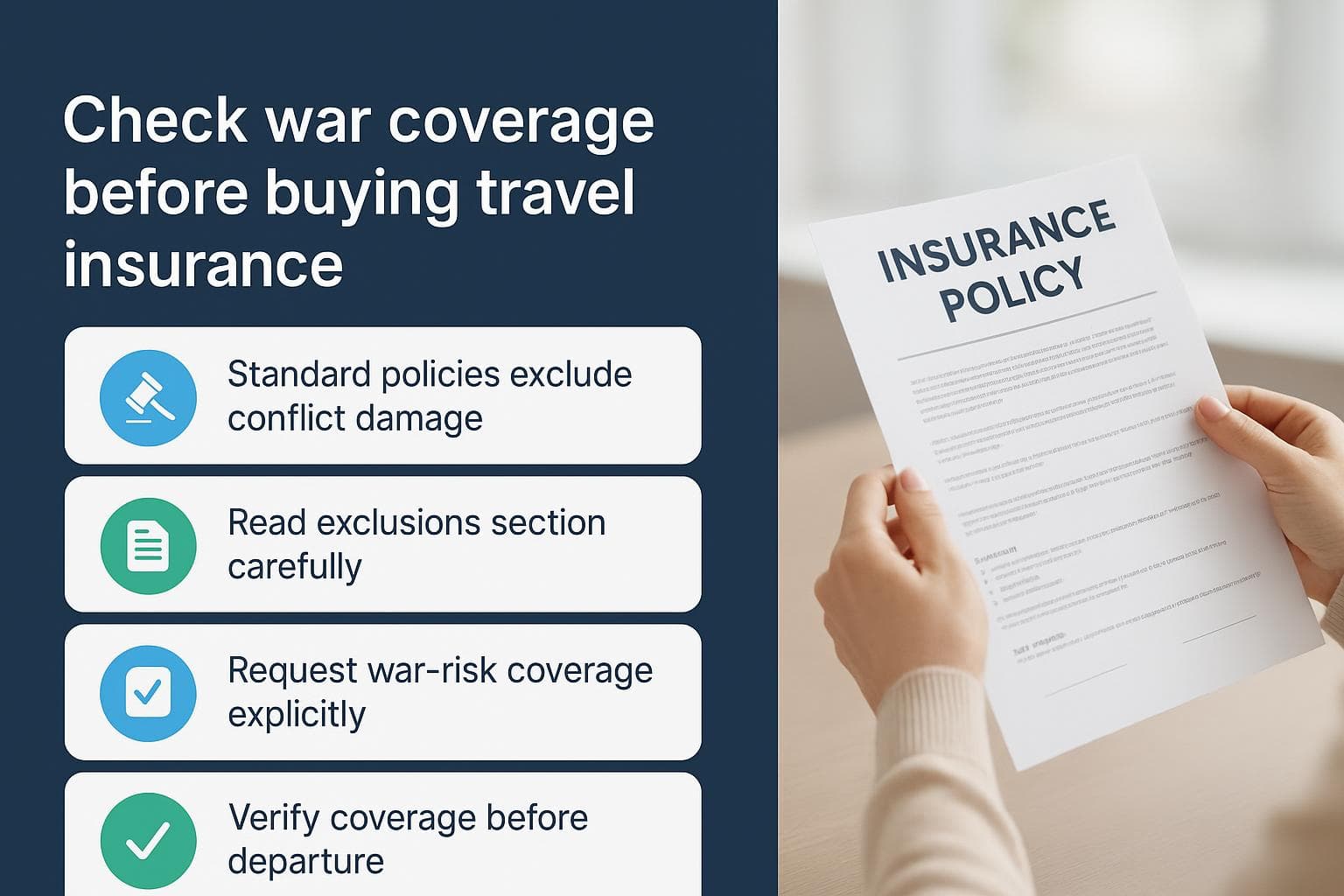
The short answer: it's not about the insurer's name
If you're searching for "which insurance companies cover Ukraine," brace yourself for an unwelcome discovery: most mass-market travel policies don't cover war risks at all. This has nothing to do with how well known the company is. Standard travel policies worldwide carry a separate carve-out along the lines of a war and terrorism exclusion — and it applies whether the name on the cover is a household one or something you've never heard of.
So the right question isn't "who," but "how do I check the terms of a specific policy." That's exactly what follows: how to read a contract in a few minutes and work out whether it will actually respond in Ukraine in 2026, relying on official sources rather than marketing.
Why an ordinary travel policy won't work here
In the vast majority of market products you'll find wording that excludes losses caused by:
- military action, invasion, acts of a foreign enemy;
- civil conflict, insurrection, martial law;
- terrorism (sometimes as a separate exclusion).
There's an additional barrier — a geographic one. Many policies are tied to the travel advice of foreign ministries. When your country's foreign ministry advises against travel, cover can lapse automatically. That's why, before buying, it's worth checking your own foreign ministry's current position and the regimes in force in Ukraine. For official Ukrainian reference points, see the website of the Ministry of Foreign Affairs of Ukraine (mfa.gov.ua) and resources on the legal regime of martial law.
The conclusion is simple: if you need genuine cover for entering Ukraine, don't look for an ordinary policy — look for a specialist policy with war and combat risk cover written in explicitly.
Checklist: how to verify a policy yourself in 10 minutes
Take the draft contract (or the IPID — the insurance product information document) and work through the points below.
1. Find the "Exclusions" section
Look for words like war, warfare, hostilities, military, terrorism. If these risks sit in the exclusions list with no exception or extension whatsoever, the policy isn't for you. A specialist product, by contrast, includes a separate clause that brings these risks back into cover (often as a distinct option or add-on).
2. Check the coverage area
Read carefully where exactly the policy applies. A correct product for Ukraine in 2026 does not exclude entire oblasts; instead, it describes restrictions through four categories of zone:
- combat zones — as defined by the relevant state acts;
- temporarily occupied territories;
- a 50-kilometre buffer strip around the first two categories;
- areas under a special-access regime.
This structure is a sign that the insurer works to current Ukrainian rules rather than sketching out cover by guesswork.
3. Check medical evacuation and repatriation
Look separately at whether emergency evacuation and repatriation are covered in high-risk conditions. In many policies, evacuation is the first thing to drop out the moment wartime circumstances are mentioned.
4. Confirm limits and assistance
Check the sum insured for medical expenses, the deductible, and whether there is a 24/7 assistance service that genuinely coordinates help on the ground.
5. Check who stands behind the policy
Before you pay, identify the insurer and the intermediary in official registers. There's a dedicated section on this below.
How to verify the insurer and agent in the registers
Don't rely on a logo on a website. Do three things:
- Regulator. A Ukrainian insurer must be supervised by the National Bank of Ukraine. The existence and status of a licence can be checked in the NBU's public registers (bank.gov.ua). For risks of this type, the relevant category is insurance class 18.
- Group and solvency. Financial strength is judged not by slogans but by membership of a group that operates under European solvency requirements (Solvency II). The product on this site is offered by an insurer regulated by the NBU (class 18 licence) and part of an EU-listed group subject to the Solvency II regime.
- Intermediary. The agent must be identifiable by its USREOU code. For our service that is USREOU 44559356; the intermediary's identity is disclosed in line with the requirements of the IDD (the Insurance Distribution Directive). You can verify the legal entity in the public state registers.
If a seller can name neither a regulator nor registration details — that's your answer already.
Where to get specialist cover
An ordinary mass-market policy, as we've established, almost always excludes war risks. The workable route is to take out a specialist policy where war and combat cover is written in explicitly and the restricted zones are described by the four categories above. It's easy to check the terms and current price through the quote request form: you'll see the cover, the limits and the price for your specific travel dates.
As for cost, the market benchmark for such products runs to a few euros per day. The exact figure depends on the length of stay, the limits and the options chosen, so the specific number is produced on the quote page rather than in an article.
What to do before you travel
- Check your foreign ministry's current advice and the legal regime in Ukraine (official sources, mfa.gov.ua).
- Run through the exclusions checklist — make sure war/combat risks are covered, not excluded.
- Match the coverage area against the four-category structure.
- Verify the insurer in the NBU register (class 18) and the intermediary by its USREOU code.
- Buy the policy for your specific dates and save the assistance service's contact details.
This approach protects you better than any list of "vetted brands": you're relying on the contract terms and official data, not on names.