The short answer: no, but with an important caveat
For the vast majority of foreign nationals, medical insurance is not a mandatory condition for crossing Ukraine's state border in 2026. As a rule, a border guard at the checkpoint won't ask to see your policy the way they ask for your passport or, where applicable, a visa.
But that doesn't mean you don't need one. This is where most search results blur a crucial distinction: being legally required at the border and the real risk of being left without coverage are two very different things. Ukraine is under martial law, and this is exactly where an ordinary travel policy lets you down — it almost always excludes losses caused by hostilities.
Below, laid out clearly: what is officially required on entry, what a standard policy doesn't cover, how to check your own policy, and where to verify against primary sources.
What is officially checked at the border
The grounds for admission or refusal of entry are determined by the State Border Guard Service of Ukraine (SBGS) under the legislation on the legal status of foreign nationals. The basic set of documents actually checked includes:
- a valid travel document (passport);
- where applicable, a visa of the appropriate type (for citizens of visa-regime countries);
- the grounds and purpose of the trip, with supporting documents on request;
- sufficient funds for the period of stay (on request).
A medical policy is not part of this basic list for most categories. Exceptions and specific requirements may apply to certain entry categories or permit types — so before travelling, verify directly against the official SBGS resource (dpsu.gov.ua) and the consular guidance of Ukraine's Ministry of Foreign Affairs.
Important: the absence of a mandatory requirement is not a green light to travel without coverage. It only means no one at the border will force you to buy a policy. The decision to protect yourself is yours.
Why an ordinary travel policy won't protect you
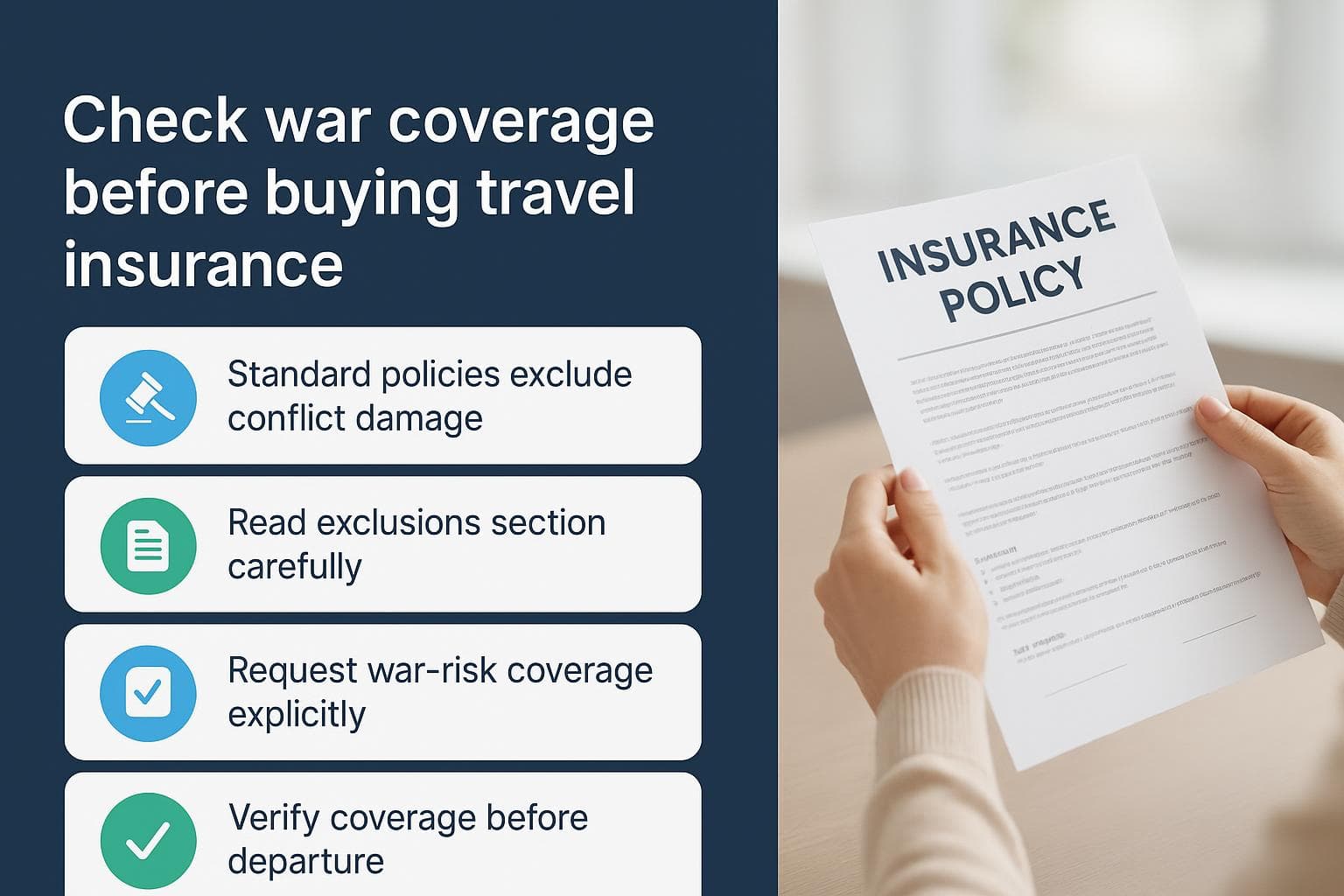
Here's the key point that often gets overlooked. Classic travel insurance is built on the assumption of a peacetime trip. In the exclusions section of almost every such contract, you'll find wording covering acts of war, armed conflict, terrorism and their consequences. That means:
- injury or death caused by shelling, a drone strike or a missile — not covered;
- evacuation from an area where hostilities are taking place — not covered;
- trip cancellation due to a deteriorating security situation — usually not covered.
In other words, you can hold a "full" policy and still have no protection against precisely the risk that defines a trip to Ukraine in 2026. There's no formal requirement at the border — but the real risk of being uninsured is very much real.
That's exactly why a separate product exists — insurance with war-risk coverage. It specifically does not exclude losses connected with hostilities, within the limits set by the contract. You can get a quote for your specific dates and route on the policy quote page — the price depends on the duration and scope of cover and is calculated individually; the indicative market range is a few euros per day.
What's covered and what's excluded by territory
War-risk coverage doesn't mean "anywhere in Ukraine." Territorial exclusions are clearly defined and apply specifically to dangerous zones — not to entire oblasts. As standard, four categories of territory are excluded:
- combat zones — as defined by acts of state authorities;
- temporarily occupied territories;
- a 50-kilometre buffer strip around both of the above categories;
- areas with a special-access regime.
Outside these zones, coverage applies. Before travelling, it's worth mapping your route against the current list of these territories — it directly affects whether the policy will respond.
Step-by-step policy check before you travel
Before setting off, run through this short checklist — it takes a few minutes and saves you from a false sense of security:
- Find the "Exclusions" section. Read how acts of war, armed conflict and terrorism are described. If these risks are excluded without qualification, a standard policy does not cover you.
- Check whether there is separate war-risk coverage and up to what sum. The mere word "Ukraine" in the contract does not guarantee coverage of hostilities.
- Match the territory of validity against the four categories of excluded zones above and against your route.
- Check the medical component and repatriation — limits, deductible, and the claims procedure in the event of a covered loss.
- Check the period of validity — it must cover every day of your stay, including the days of entry and exit.
- Save the assistance contacts and policy number on your phone and on paper.
If even one point raises doubt, clarify it with the insurer in writing before the trip — not after an incident occurs.
Who stands behind the policy (and why it matters)
The reliability of coverage is determined not by advertising but by who bears the obligations. The risk is underwritten by an insurer operating under the supervision of the National Bank of Ukraine (licence class 18), part of a group listed on an EU stock exchange and subject to the solvency requirements of Solvency II. Policies are sold by an agent (USREOU 44559356) in accordance with the disclosure requirements of the Insurance Distribution Directive (IDD). This means transparency about who you are entering into a contract with and who will be responsible for paying claims.
Official sources current for 2026
Before travelling, verify against primary sources rather than forums:
- State Border Guard Service of Ukraine (dpsu.gov.ua) — border-crossing rules, checkpoint operations, restrictions;
- Ministry of Foreign Affairs of Ukraine (mfa.gov.ua) and its consular network — visa requirements and guidance for foreign nationals;
- National Bank of Ukraine (bank.gov.ua) — the register of insurers and licence verification;
- the current list of combat zones and temporarily occupied territories — per the official acts of the authorised bodies.
Security rules and access regimes can change rapidly, so check the status immediately before departure.