Insurance
Ukrainian-licensed travel insurance with war-risk coverage. Transparently — how it works, what it covers, where the limits are, and why it differs from international travel policies.
Latest additions
Fresh guides and the latest updates in this section
Travel Insurance for a Trip to Ukraine in 2026: How Czech Travellers Can Find War-Risk Cover
The standard travel policy Czech travellers buy before heading abroad almost always does NOT cover war and combat risks — it's a routine exclusion written into the contract. Below we explain why that is, how to check whether war-risk cover is actually included, and walk you through, step by step, how to arrange the right policy specifically for entering Ukraine.
Travel Insurance with War-Risk Cover for Entering Ukraine in 2026: How to Vet Your Policy Before You Travel
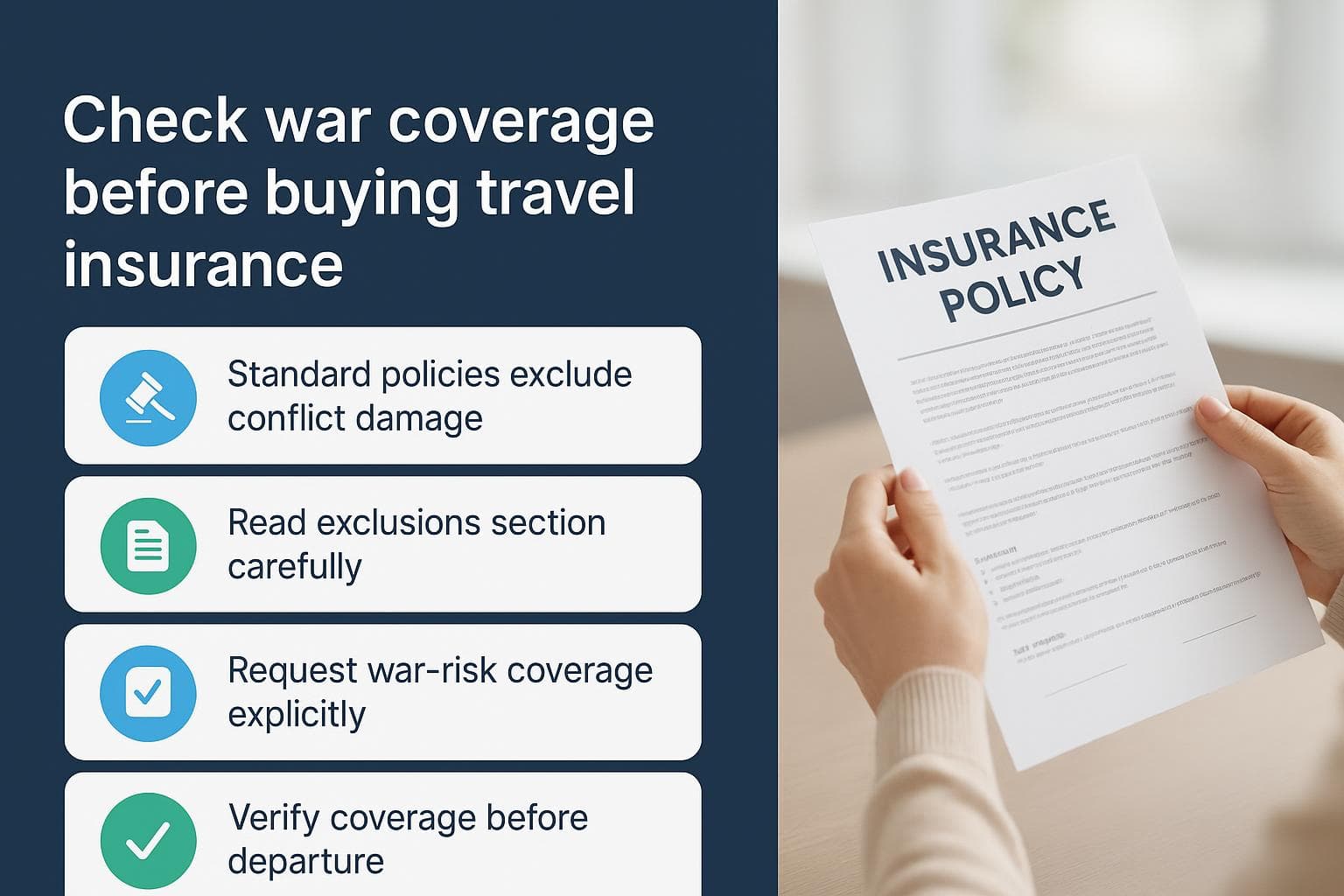
Most standard travel policies quietly exclude anything caused by hostilities — which is exactly why a foreign visitor planning a trip to Ukraine in 2026 needs to do more than simply buy insurance. You have to know how to read the wording and confirm that war risks are genuinely covered. Below is a practical checklist of the policy sections to examine, plus a step-by-step process for getting a quote.

Travel Insurance with War-Risk Cover for Trips to Ukraine (2026): How to Choose and Buy One
Most standard travel policies explicitly exclude anything war-related. So for a trip to Ukraine in 2026 you need a separate product — one with clearly stated war-risk cover. Here's why that's the case, the checklist to use when choosing a policy, and how to get an online quote step by step.
Travel Insurance for a Trip to Ukraine in 2026: What a Policy With War-Risk Cover Must Include
Ordinary travel insurance often doesn't work where war risks exist. Here's exactly what a policy for entering Ukraine in 2026 needs to cover, the exclusions you'll come across most often, and how to arrange your protection step by step.

Travel Insurance for a Trip to Ukraine in 2026: War-Risk Coverage and How to Get It Step by Step
Most standard travel policies exclude anything connected to war — which is exactly why foreign visitors planning a trip to Ukraine in 2026 need a dedicated product with clearly stated war-risk coverage. Below is a straightforward explanation of what such a policy actually includes, a checklist of terms to look for, and a step-by-step guide to buying it online.
Is Insurance Mandatory to Enter Ukraine in 2026: Official Requirements and War Risks
Technically, medical insurance is not a universal condition for crossing into Ukraine for most foreign nationals — but that doesn't mean you don't need a policy. Here's what border guards actually check, and why no ordinary travel policy covers the consequences of hostilities.
Travel Medical Insurance for Ukraine in 2026: Does It Cover War, and How to Get It
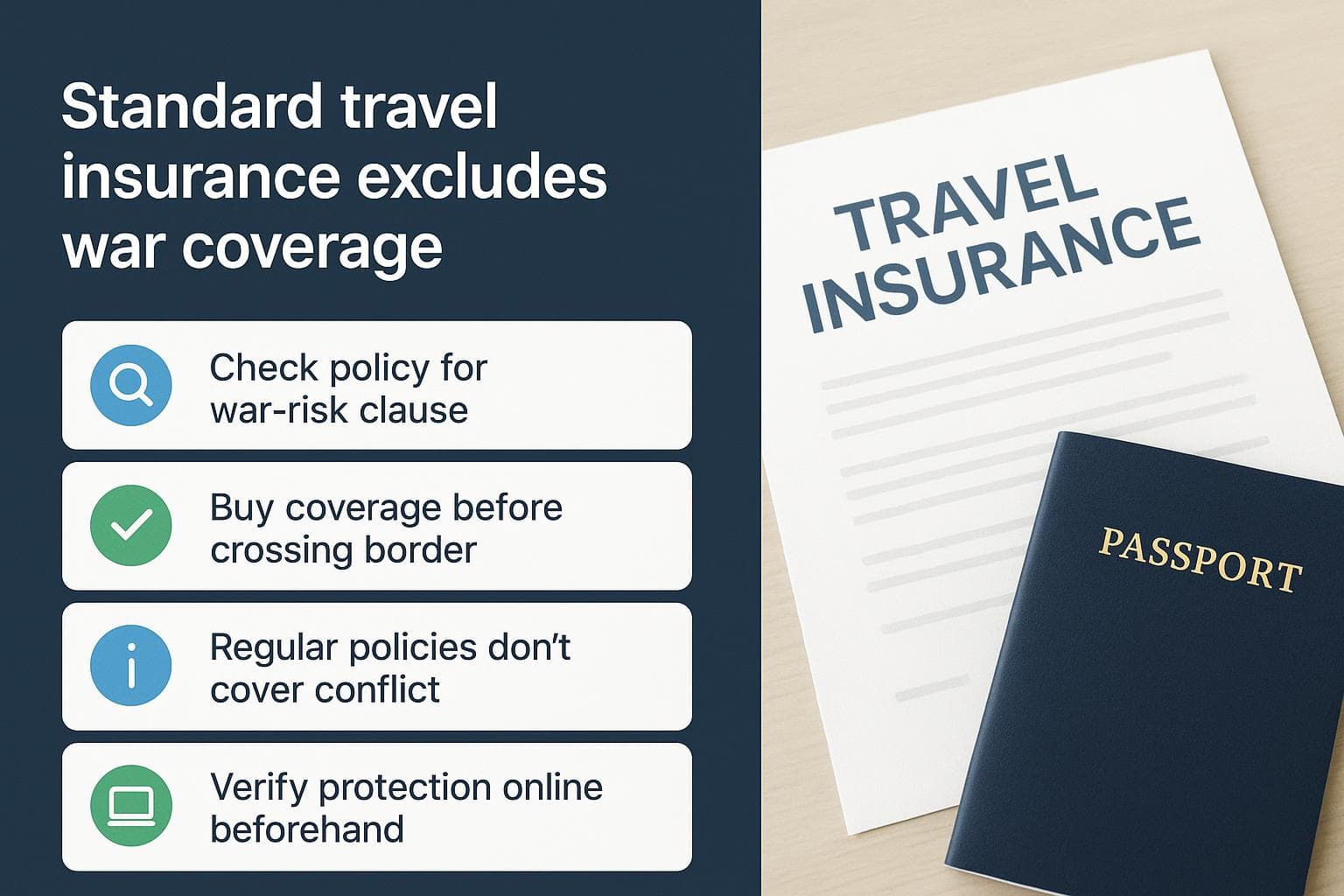
A standard travel medical policy and war-risk cover are two very different things. Here's why ordinary insurance usually doesn't apply in a conflict zone, how to check whether your policy actually includes war-risk, and how to arrange protection online before you even reach the border.
Which insurers cover trips to Ukraine in 2026: how to check war-risk cover without playing the brand game
Instead of scrolling through lists of insurer names, learn how to check in ten minutes whether a specific policy actually covers war and combat risks for entry into Ukraine. Below is a step-by-step checklist backed by official registers and sources rather than advertising promises.
How to Buy Travel Insurance for a Trip to Ukraine in 2026: A Step-by-Step War-Risk Coverage Checklist
A standard travel policy almost always excludes war risks — so a trip to Ukraine calls for a separate plan with the right coverage. Below is the real, practical sequence from requesting a quote to holding a finished policy, plus the must-have coverage points and the official sources for checking a region's status.
Travel Insurance With War-Risk Cover for Entering Ukraine: How to Choose in 2026
Standard travel policies almost always exclude losses caused by acts of war. That's why a trip to Ukraine under martial law calls for separate war-risk cover. Here's how to choose it, what to check before you pay, and where to find the official entry requirements.

Does Ukraine Count as Europe for Travel Insurance With War-Risk Cover (2026)
Geographically, yes — Ukraine is part of Europe. But for a travel insurance policy that barely matters: what counts is not the continent, but the policy's rating zone and whether war-related exclusions apply. Here's why a standard "Europe" policy often does NOT include Ukraine, and how to check it step by step.

How to Buy Travel Insurance With War-Risk Cover Online for a Trip to Ukraine (2026)
Standard travel policies usually exclude any harm caused by armed conflict. For a trip to Ukraine in 2026 you need a different kind of cover — one with a war-risk extension. This guide explains how such a policy differs from an ordinary one, how to arrange it online in a few minutes, and what your contract must include.

How to Buy Travel Insurance for a Trip to Ukraine with War-Risk Cover: A Step-by-Step Guide for 2026
Most standard travel policies quietly exclude anything caused by combat operations — which is exactly why anyone travelling to Ukraine needs a policy that spells out war-risk cover in black and white. Below is a transparent, step-by-step online process, the documents you'll need at the border, and links to the official sources for entry requirements.
Medical Travel Insurance for Ukraine in 2026: Coverage, Treatment Limits and Medical Evacuation
Traveling to Ukraine during the war takes more than courage — it takes a clear head. The medical side of a travel policy gets far less attention than war-related risks, yet it's the part that kicks in most often: a sudden illness, an injury, the need for hospital care or evacuation. Here's what a policy actually covers, how the limits work, and how medical care and patient transport are handled on the ground.
How Much Does Travel Insurance for Ukraine Cost in 2026: Real Price Examples by Trip Length and Coverage Type
You've already decided to take out a policy for your trip to Ukraine and want to know what it'll set you back. Below are transparent pricing scenarios for trips of 3, 7, 14 and 30 days, an explanation of what drives the cost, and a fast route to buying online.
The Cost of Travel Insurance With War-Risk Cover for Ukraine in 2026: What Drives the Price of a Policy
How much does a travel policy with war-risk cover for a trip to Ukraine actually cost, and why can two travellers end up paying twice as different amounts? We break down every factor behind the price, walk through sample quotes, and explain how to avoid paying for extras you don't need.
Who Travels to Ukraine in 2026 and Which War-Risk Insurance Suits Each Type of Visitor
Tourist, business traveller, volunteer, member of the diaspora or journalist — everyone comes to Ukraine with a different set of risks. Here's how to match a war-risk insurance policy to your specific trip profile, and why there's no such thing as a one-size-fits-all solution.
War-Risk Insurance for Foreigners in Ukraine in 2026: How to Vet an Insurer During Wartime
A policy that mentions "war risks" is not a guarantee that you'll ever be paid. In this guide we show foreigners how to check whether an insurer is genuinely reliable during an active war — from its National Bank licence to the wording of territorial exclusions, which directly determine whether you actually collect on a claim.
Ukrainian Insurers Covering War Risks in 2026: Terms, Limits, and How to Get a Policy During Wartime
With the war ongoing, most standard travel policies simply don't apply — war risks are excluded by default. Here's a clear look at which Ukrainian insurers actually offer coverage for foreign visitors in 2026, how their terms and limits differ, and how to buy a policy without leaving home.
Travel Insurance Companies for Ukraine in 2026: Who Covers War Risks and How to Choose a Reliable Insurer
Most ordinary travel policies explicitly exclude acts of war — so a trip to Ukraine calls for specialised cover. Here's who actually insures foreign visitors during wartime, how to gauge whether an insurer is trustworthy, and how to confirm that war risks are genuinely part of your contract.
Travel Insurance for Visitors to Kyiv in 2026: A War-Risk Policy Built for the Capital
Planning a trip to Kyiv in 2026? Here's how travel insurance with war-risk cover works specifically for the capital, what to keep in mind because of air-raid alerts, how local assistance and hryvnia payouts work — and where to arrange a policy online in just a few minutes.
Buy Travel Insurance for Ukraine Online in 2026: A Step-by-Step Walkthrough from Form to Policy in Your Inbox
If you're planning a trip to Ukraine and want to sort out your policy right now, this guide walks you through the entire purchase — from filling in the form to receiving the finished document in your inbox within minutes. No unnecessary theory: just concrete steps, the list of details you'll need, and a clear explanation of how war-risk cover works.
The Best Travel Insurance for Ukraine in 2026: How to Compare Policies and Pick the Right One
What counts as the "best" travel insurance for Ukraine stays subjective until you break it down into specific, measurable criteria. This guide shows which factors to check before buying, how to weigh them for a trip to a country under active martial law, and how to avoid a policy that, in practice, covers nothing.
Is Ukraine in the "Europe" Zone for Travel Insurance in 2026?
Plenty of travelers spot the word "Europe" in a tariff table and assume Ukraine automatically falls under standard European cover. Insurance geography is more nuanced than that. Here's how Ukraine is classified in 2026, why it affects the price, and why a policy without separate war-risk cover may simply fail to pay out.
Fundamentals
Buyer's guide, war-risk coverage, and an honest comparison with international policies.
Travel Insurance for Ukraine 2026: The Complete Buyer's Guide
Most guides to travel insurance for Ukraine open with a price comparison — and that's the worst possible starting point. The structurally correct question is about the **operational chain**: when you fall ill in Lviv on a Saturday night, or need emergency care after an incident, how many steps and how much time sit between your call to the 24/7 line and the moment you actually receive treatment? Do you pay out of pocket in your home currency, or does the clinic settle directly with the insurer? Is the 24/7 dispatcher physically located in Ukraine, or is the call routed into a global assistance pool somewhere in Western Europe? This guide explains how to read an insurance product through that lens — and why Ukraine in 2026 is structurally different from a typical tourist destination.
War-risk travel insurance for Ukraine: what's covered, what isn't
«War-risk coverage» is a phrase where the devil is in the details. Our partner's product includes such coverage as an **optional activation** (insurance event 4.1.1 in the «Brave» programme GTCP), not as an abstract promise. This article explains concretely: which incidents are covered when the option is active, which zones are territorially excluded (no euphemisms), how the claim flow looks under a war-related incident, and where there is an **honest gap** — situations in which even our product will not cover you and you need to know about it before purchase.
Travel insurance for Ukraine vs international providers: a comparison of two operational chains
This is **not** an article saying «buy our insurance because it's better». There is no absolute «better» in insurance: a mass-market traveller policy purchased online from your home market, and a policy underwritten by a Ukrainian insurer regulated by the National Bank of Ukraine, are **operationally different by construction** — they have a different assistance-network architecture, different currency settlement, different territorial logic, different treatment of war-and-terrorism. This article is the spine of the entire A-cluster: it lays out **two operational chains** that resolve the same baseline medical scenario, with no brand strawmen, no evaluative claims, no emotional argument. You draw the conclusion, not us.
By audience
Journalists and NGO workers; returning diaspora.
Travel insurance for journalists and NGO workers in Ukraine: where our product is optimal, where the honest frontline gap is
This is a segment-aware article for people whose work in Ukraine places them in a more complex context than an ordinary trip: correspondents, fixers, documentarians, humanitarian-organisation workers, volunteer-programme coordinators. **This is not «buy our insurance — it's perfect for journalists».** The honest note we build the entire A-cluster positioning on ([A3 comparison](/insurance/travel-insurance-ukraine-comparison) makes it explicit): our partner's Ukrainian war-risk policy is **optimal as base coverage** for non-frontline reporting; for frontline assignments — **not sole coverage**, but a component of a combined package paired with niche specialised products (K&R riders, repatriation flight from frontline, security broker integration) that we **don't offer**. The article explains where the line is, what's covered, what isn't, and how to combine.
Insurance for diaspora visiting Ukraine: UAH direct billing, native-language dispatcher, NBU jurisdiction — why Chain B fits the family context naturally
Diaspora trips to Ukraine are a distinct emotional + practical context: visiting elderly parents, helping with repair after damage, attending a family wedding, baptism or funeral, coordinating with UA NGOs. This isn't «foreign visitor» in the classical sense — you have a native language, relatives who can help on the ground, bank accounts in two countries simultaneously. **This article is the segment-aware variant** of the A-cluster positioning ([A3 comparison](/insurance/travel-insurance-ukraine-comparison) as the spine), focused on three structural advantages especially relevant to diaspora: UAH direct billing without cross-border conversion, a Ukrainian-speaking in-country dispatcher (critical for helping relatives), close UA jurisdiction for disputes. Compliance: no brand strawmen, factual structural language, substantiable from §X GTCP «Brave».
Process and options
How to file a claim inside Ukraine; the radiation-protection rider.
How insurance claims work inside Ukraine: nuts-and-bolts of Chain B
[The A3 comparison](/insurance/travel-insurance-ukraine-comparison) showed that Chain B (Ukrainian insurer) has ~4 touchpoints against ~10 in Chain A (mass-market). This article is the **operational breakdown of those 4 touchpoints** down to the level of steps, documents, time windows, and edge cases. No brand strawmen, no «faster than competitors» promises; substantiable from §X GTCP «Brave» (Acceptance file in the repo) + general product-type characteristics + NBU regulatory acts. This is the **process trust** article: you see exactly what each step looks like before buying.
Event 4.1.2 radiation rider: when to activate, what it covers, who needs it
Event 4.1.2 is a separate optional activation in the «Brave» program GTCP (our partner PJSC «IC EUROINS UKRAINE») covering medical consequences of contact with ionising radiation. This is a **niche, narrow-technical** component of the A-cluster — not for ordinary tourists. In this article: precise coverage wording from §8 Acceptance, when activation makes sense, when it's overkill, how to activate, how to file a claim. Compliance: substantiable from §8 Acceptance of the «Brave» program; cross-link to [A2 full disclosure of event 4.1.1+4.1.2](/insurance/war-risk-travel-insurance-ukraine).
By duration and FAQ
Short trips, long stays, frequently asked questions.
Travel insurance for short trips to Ukraine (3-14 days) — conferences, weekend visits, family events, Carpathian ski trips, multi-trip alternative
Short trips to Ukraine — 3-14 days — are the most common A-cluster use case: a business conference in Kyiv, a cultural weekend in Lviv, a ski trip to Bukovel, a family event in Odesa, a short journalist assignment, a diaspora weekend visit to relatives. This article is a period-specific guide for that 3-14 day window: coverage scope, how the period-tariff structure works, what to do about extension and gap, when the multi-trip alternative is more cost-effective than separate single-trip purchases.
Long-stay travel insurance for Ukraine (30-180 days) — caring for elderly relatives, sabbatical, NGO mission, family property reconstruction
Long stays in Ukraine — 30-180 days — are a distinct use case for diaspora returning to care for elderly parents, for NGO/journalist missions with extended timeframes, for a sabbatical year, for the reconstruction of family property in northern / western / central Ukraine. This article is a period-specific guide for that 30-180 day window: symmetrical to [A8 short-trip](/insurance/short-trip-insurance-ukraine), but with differences in edge cases (renewal beyond 180 day max, pre-existing conditions matter more, regular check-ups during a 6-month stay).
Ukraine travel insurance FAQ — 22 typical questions answered: basics, war-risk, claims, period, pricing, niche segments
This is the FAQ hub of the UkraineBorder.com A-cluster — a distillation of key questions and answers from articles A1-A9. Structured by 6 themes for quick reference: **Basics** (5 Q), **War-risk** (4 Q), **Claims process** (3 Q), **Period** (3 Q), **Pricing** (2 Q), **Niche segments** (5 Q). Each answer is distilled from the corresponding spoke article; for full disclosure follow the cross-links. FAQPage schema for Google rich snippets. Compliance: no literal prices, no brand strawmen, no absolute claims; substantiable from §X GTCP «Brave» (PJSC «IC EUROINS UKRAINE»).