The key thing to grasp right away
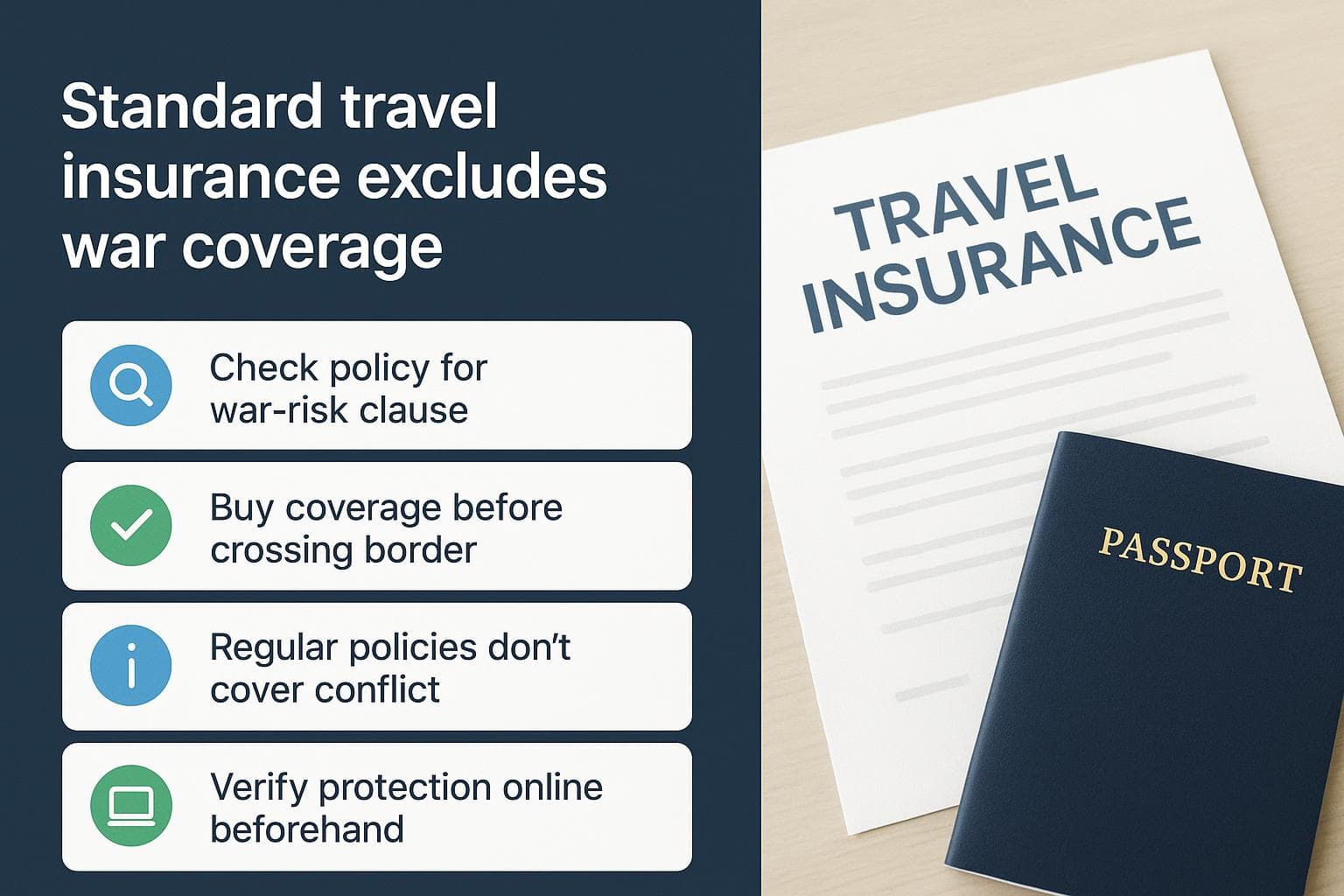
Most ordinary travel policies contain an outright exclusion for any loss arising from war, armed conflict, shelling or similar events. That comes down to a simple but important fact: if you buy a standard "holiday" policy and travel to Ukraine, there's a strong chance it won't respond during martial law — precisely when you'd need it most.
The answer is separate war-risk cover. This isn't a "peace-of-mind surcharge"; it's a functional part of the policy that determines whether your medical treatment and evacuation will actually be paid for if something happens that's linked to combat operations.
Why an ordinary policy won't do
Travel insurance was historically built around peacetime scenarios: injuries, sudden illness, lost luggage. War risks are the classic exclusion, written into the terms in fine print. So the main question when choosing isn't the price or the loud promises — it's whether the contract states explicitly that war risks are included rather than excluded.
If the policy wording contains something like "the insurer is not liable for loss resulting from acts of war" with no separate extension of cover, that document is no good for a trip to Ukraine.
Checklist: what your policy must include
Before you pay, make sure the contract covers at least the following:
- Medical expenses — outpatient and inpatient treatment, including in connection with war-related events.
- Medical evacuation and repatriation — transport to a suitable clinic or back to your home country.
- A clearly defined coverage area under martial law — exactly where the policy works and where it doesn't.
- Round-the-clock assistance — a contact you can reach from abroad.
- Transparent exclusions — you should see the limits of cover before your trip, not after an incident.
Market prices run to a few euros a day; the exact cost depends on the length of the trip, your age and the options you choose, and it's calculated at the checkout stage.
How the coverage area works: four categories of exclusions
No reputable policy covers the entire country without limits — and that's normal. Rather than excluding whole regions, proper cover defines exactly four categories of zones where the insurance doesn't apply:
- Combat zones — as designated by the relevant state acts.
- Temporarily occupied territories.
- A 50-km buffer strip around both of the above.
- Areas under a special-access regime.
Everything outside these four categories stays within the policy's coverage. So don't trust wording that says "doesn't apply to such-and-such oblast in full" — the correct model is tied to zones, not to administrative borders.
The step-by-step process
- Check the current entry requirements. Rules change during martial law, so rely on official sources: the State Border Guard Service of Ukraine (dpsu.gov.ua) and the Ministry of Foreign Affairs (mfa.gov.ua).
- Set your route and dates. Knowing your cities and dates makes it easier to match the cover and confirm your route doesn't pass through excluded zones.
- Calculate the cover. Fill in your details and get a quote on the policy checkout page — that's also where the final price is shown, with no hidden add-ons.
- Read the war-risk terms specifically. Find the section on war and make sure it extends rather than restricts your cover.
- Save the policy and the assistance contact — in both printed and electronic form, with the support phone number.
How to confirm a policy is valid for an active zone
Ask yourself three things before you pay: are war risks explicitly listed as covered; is the coverage area described through the four exclusion categories (not by oblast); and is medical evacuation included? If the answer to all three is "yes" and these terms are set down in writing in the contract, the policy is fit for the trip.
Also cross-check your planned route against the current restrictions. If your destination falls into one of the four excluded categories, the insurance won't apply there no matter what the policy says — that's a physical limitation, not a contractual one.
Who issues the policy and through whom
The insurance is provided by a company regulated by the National Bank of Ukraine (licence class 18) that belongs to a European group listed on a stock exchange and subject to Solvency II requirements. The policy is arranged through an agent with USREOU code 44559356; identity details are disclosed in line with the requirements of the Insurance Distribution Directive (IDD). That means a transparent structure: you know who the insurer is, who the agent is, and the rules the contract runs by.
In summary
For a visit to Ukraine in 2026, ordinary travel insurance isn't enough — you need separate war-risk cover with medical expenses, evacuation and a clearly defined coverage area. Check the contract wording against the checklist, cross-reference your route against the four categories of excluded zones, and always rely on official sources for entry rules.