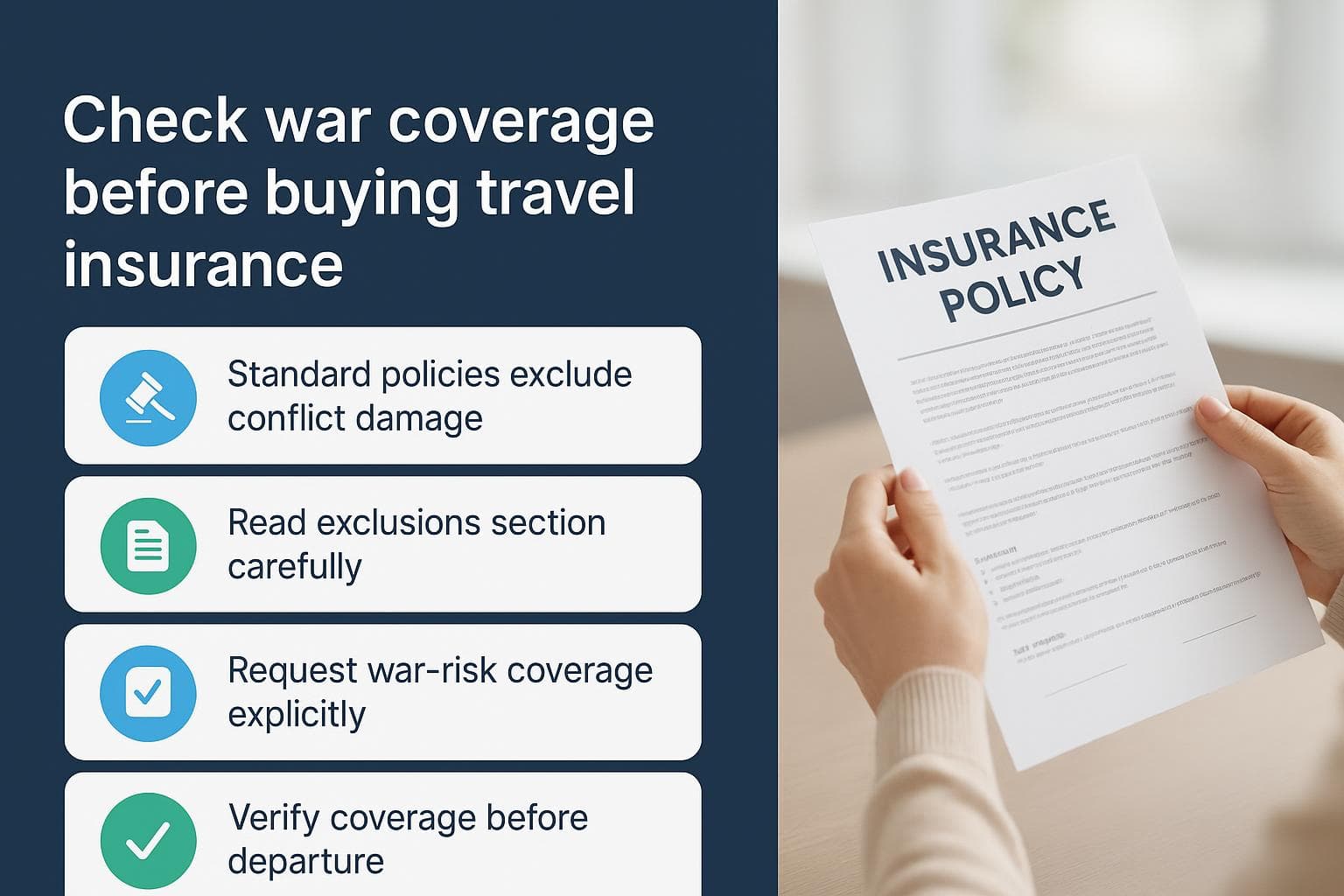
The short answer: a standard travel policy won't protect you
The vast majority of mass-market travel policies sold for trips around the world contain an explicit exclusion for losses connected to war, armed conflict, hostilities, and similar events. This is standard market practice, and it isn't buried to deceive you — the risk is simply placed outside the scope of the base cover. For most destinations, that makes no difference at all. For a trip to Ukraine in 2026, while martial law remains in force, it is the decisive point.
So if you buy a policy "the way you always do," there's a strong chance that anything arising from hostilities is not covered. The good news: there are policies designed specifically for entry into Ukraine, where war risks are written directly into the cover. Your job as a traveller is to learn how to tell the two apart before you fly.
Why the exact wording matters so much
A product name — "insurance for Ukraine," "policy with war-risk cover" — guarantees nothing on its own. What matters is the text of the terms. A policy might advertise war-risk cover in its marketing blurb yet keep clauses in the exclusions section that effectively cancel that cover out. So don't judge the cover by its label; check the specific clauses of the contract.
The second reason is territorial limits. Even a properly written policy with war cover does not apply across the entire country without exception. There are zones where cover simply does not extend, and that is both normal and lawful. It's important to know these boundaries in advance so you don't plan a route through territory where the policy won't work.
Checklist: what to read in the exclusions
Open the "Exclusions" section and find answers to the following:
- Is there a general war exclusion? Wording along the lines of "war, invasion, acts of a foreign enemy, hostilities" in the exclusions is a red flag. If it's there and isn't reinstated anywhere by a separate extension, the policy isn't for you.
- Is there a separate war-risk extension that puts this risk back into cover? This is precisely what makes a policy suitable for Ukraine. Look for a clause that expressly states that the consequences of hostilities, shelling, drone strikes, and the like fall within the cover.
- How is terrorism treated? Hostilities and terrorism are often split into separate clauses. Make sure neither of them is left sitting in the exclusions.
- Is the whole destination excluded outright? Some policies exclude Ukraine as a country entirely. That's the exact opposite of what you need.
Checklist: what should be in the benefits
In the Coverage / Benefits section, confirm that at a minimum you have:
- Emergency medical treatment for events connected to war risks, not just "ordinary" illness and injury.
- Medical evacuation and repatriation — a critical item in an area with active risks.
- A sufficient limit of liability that genuinely covers the cost of complex treatment, not just a token amount.
- A clearly stated period of validity — the start and end dates of cover must fully span your stay, including your days of entry and exit.
The four categories of territorial exclusions
Even under a policy with war cover, protection does not extend to certain territories. This is a standard structure, and it is described not by whole regions but by four categories of zones:
- Areas of active hostilities, as defined by the relevant acts of state authorities.
- Temporarily occupied territories.
- A 50-km buffer zone around the territories in the first two categories.
- Areas under a special access regime.
Plan your route so that it lies entirely outside these four categories of zones. Their scope changes with the situation on the ground, so before you travel, check against current official data rather than last year's map.
How to verify martial-law status and official guidance for 2026
Before you plan anything, check the primary sources:
- Current status and any extension of martial law are published through official acts on Ukraine's legislation portal (rada.gov.ua) and on the website of the President of Ukraine (president.gov.ua).
- Practical advice for foreign visitors and consular contacts are on the website of the Ministry of Foreign Affairs of Ukraine (mfa.gov.ua).
- Border-crossing rules and lists of checkpoints are on the resources of the State Border Guard Service of Ukraine.
These sources take priority over any aggregators or travel blogs, because they are updated officially.
The step-by-step process for getting a quote
- Pin down your exact dates of stay — from the day you enter to the day you leave. The policy must cover the whole period without gaps.
- Lock in a route that does not pass through any of the four exclusion categories described above.
- Fill in the quote form, entering your country of citizenship, dates, and the options you need. You can run the calculation on the policy quote page.
- Check the terms against the checklists in this article — the exclusion and reinstatement of war risks.
- Save the policy and the assistance contacts offline: both printed and on your phone, because connectivity can be unreliable.
On cost: on the market, policies of this kind run to roughly a few euros a day, but the exact price depends on your dates and options and is entered on the calculation page — there's deliberately no fixed price list here, because it's individual.
What to check on the regulatory side
An insurer's transparency is a form of protection in itself. A proper policy for entering Ukraine is issued by an insurer regulated by the National Bank of Ukraine (licence class 18) that belongs to a group listed on an EU exchange and subject to Solvency II requirements. The agent through whom the policy is arranged has USREOU code 44559356, and in line with insurance distribution requirements (IDD), its status is disclosed before the contract is concluded. Having these details available is a sign that you're dealing with a regulated market participant rather than a random intermediary.
Summary
The point isn't to "buy insurance" — it's to buy the right insurance. Read the exclusions and benefits against the checklist, confirm that war risks are reinstated by a separate extension, plan your route outside the four categories of zones, and cross-check martial-law status against official sources. Then the policy will actually work when you need it.