First things first: you can't fly into Ukraine right now
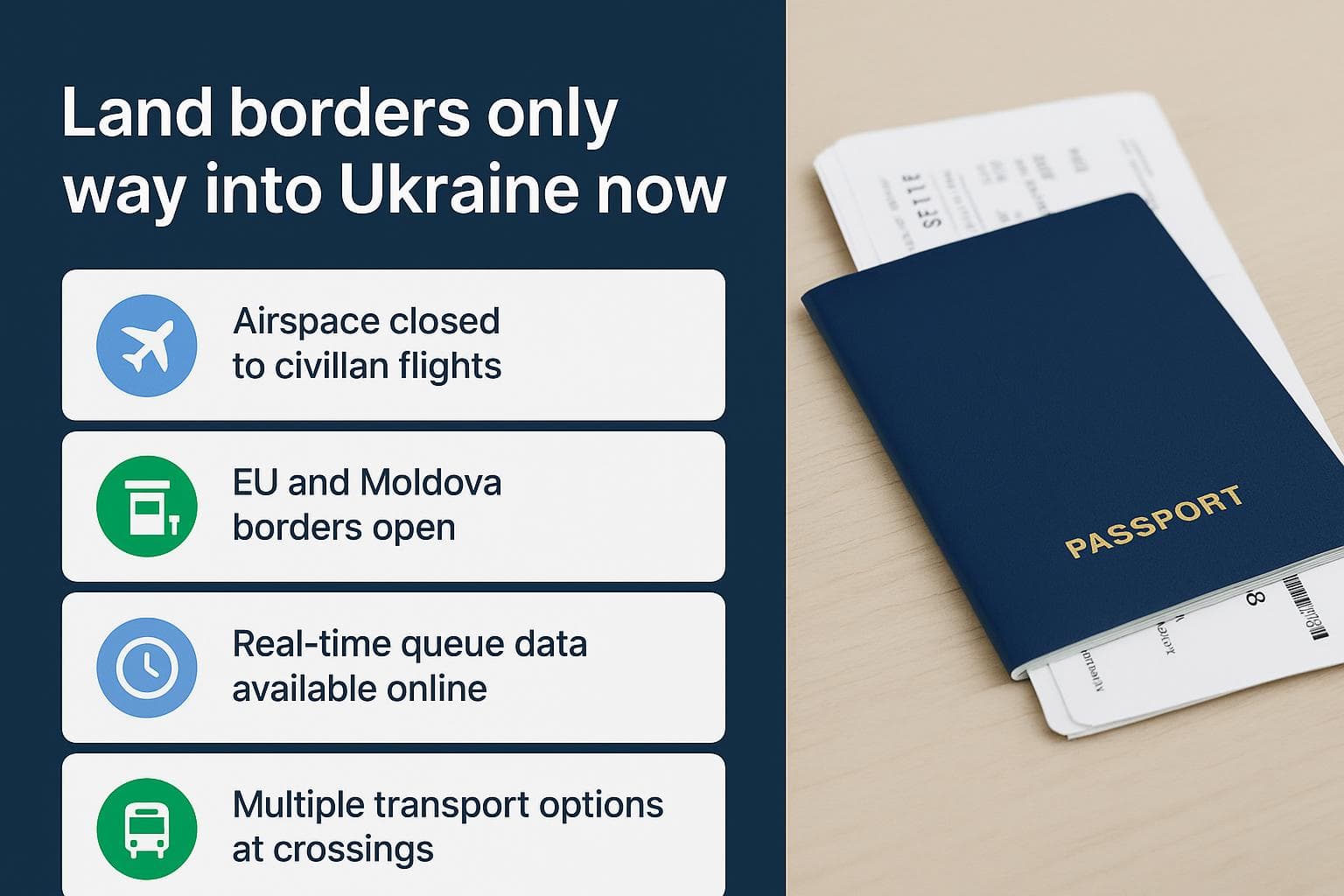
If you've been searching for a flight to Kyiv, Lviv or Odesa, the short answer is no. Under martial law, Ukraine's civilian airspace is closed, and in 2026 there are no scheduled passenger flights operating within the country. Airports are not accepting commercial civilian aircraft.
This isn't a dead end — it just changes the logic of the trip. The workable route is to fly into a neighbouring EU country (most often Poland, Slovakia, Hungary or Romania) or Moldova, then travel to the Ukrainian border by land and cross at one of the active land checkpoints. That's what the rest of this article is about.
The overall logic of a route through a neighbouring country
Planning always breaks down into two parts: the international flight to a hub near Ukraine and the overland leg to the border and onward into the country.
The most popular transit airports:
- Poland — Warsaw, Kraków, Rzeszów. Rzeszów is the closest to the Ukrainian border, and it's a convenient starting point for heading to Lviv.
- Hungary — Budapest, giving access to the Zakarpattia crossings.
- Slovakia — Košice, also heading towards Zakarpattia.
- Romania — Bucharest, Suceava, heading towards Chernivtsi and the south.
- Moldova — Chișinău, a gateway to southern Ukraine.
Choose your hub not by ticket price but by which part of Ukraine you need to reach. An extra couple of hundred kilometres of overland detour will cost you more than the difference in airfare.
What documents a foreigner needs
The basic set depends on your nationality, but for most visitors the following apply:
- A passport valid for the entire duration of your trip.
- A visa — if your country doesn't have a visa-free arrangement with Ukraine. Check the list and conditions on the official website of Ukraine's Ministry of Foreign Affairs (mfa.gov.ua) and with your consulate.
- Grounds and purpose of visit — a border officer may ask you to explain the reason for your trip, along with bookings, return tickets or an invitation.
- An insurance policy valid in Ukraine under martial law. This is a critical document: ordinary travel policies almost always exclude risks connected to hostilities.
A separate category is the rules for bringing in vehicles, animals, cash and medicines. These are set by the State Customs Service; check the current limits on customs.gov.ua, since thresholds and requirements change periodically.
Insurance that actually works during wartime
Standard travel medical insurance usually doesn't cover incidents caused by hostilities — and that is precisely the risk that sets a trip to Ukraine apart from any other. That's why you should take out a policy that explicitly includes war risks, and do it before you cross the border.
On the market, such policies cost roughly a few euros per day of coverage — you'll see the exact amount on the quote page, since it depends on the duration, your age and the scope of coverage. You can arrange a suitable policy online in a few minutes: get an insurance quote.
When choosing, read the territorial exclusions section carefully. A proper policy doesn't exclude entire regions — it describes exactly four categories of zones:
- combat zones — as defined by the relevant government acts;
- temporarily occupied territories;
- a 50-kilometre buffer strip around the first two categories;
- areas under a special-access regime.
If an insurer instead "carves out" whole regions by listing them, that's a reason to clarify the terms, because zone boundaries shift and are defined by government acts rather than by administrative divisions.
Entering by car
Your own vehicle is flexible, but not always the fastest option, since popular routes can have long queues.
Step by step:
- Choose a road checkpoint for your direction (for example, Krakivets, Shehyni, Uzhhorod, Porubne, Diakove and so on).
- Check the checkpoint's traffic load and the estimated waiting time in advance (see the section on sources below).
- Prepare your vehicle documents, vehicle insurance and personal papers.
- Clear the EU country's exit control, then Ukrainian border and customs control.
Wait times by car are the least predictable: at peak periods they run into hours. Don't plan tight connections.
Crossing on foot
Some checkpoints have a pedestrian corridor. This is a lifesaver when the car queue is enormous: you leave your vehicle (or step out of a taxi) on the EU side, clear control on foot, and pick up transport again on the Ukrainian side.
Whether a pedestrian crossing exists varies by checkpoint and can change, so check this for your specific crossing in advance. Bear in mind that on foot you'll have to carry all your luggage yourself across the entire distance between the control lines.
Entering by bus
International buses are the simplest option for those without a car. Operators run from major EU cities to Lviv, Kyiv, Uzhhorod and other cities.
What to know:
- Buses often have a dedicated lane at checkpoints, but with a full coach the control of all passengers still takes time.
- The ticket usually covers the whole "EU city — Ukrainian city" route, with no separate transfers at the border.
- Keep your documents and policy handy — control takes place right on the bus or nearby.
Entering by train
The railway is one of the most comfortable and predictable ways in. International trains run, including from Poland (the Przemyśl — Lviv — Kyiv route) and other neighbouring countries.
Advantages:
- Border and customs control take place right in your carriage during the stop — no standing in a physical queue.
- The schedule is stable and journey times are predictable.
- Tickets for domestic routes within Ukraine are easy to buy online on the official website of Ukrzaliznytsia (Ukrainian Railways).
Because demand is high, trains from the EU sell out well in advance — book as early as you can.
Where to check checkpoint status and wait times (official sources)
Don't rely on old blogs or someone else's screenshots of queues — the situation changes daily. Use primary sources only:
- State Border Guard Service of Ukraine (dpsu.gov.ua) — checkpoint status, live information on traffic load and queues.
- Ministry of Foreign Affairs of Ukraine (mfa.gov.ua) — visa regime, the list of visa-free countries, consular information.
- State Customs Service (customs.gov.ua) — rules on bringing in goods, vehicles and cash.
- Ukrzaliznytsia (official website) — train schedules and tickets.
Before setting off, do a final check on the status of your specific checkpoint — some may temporarily change their operating regime.
A quick pre-trip checklist
- You've chosen a hub in a neighbouring country to match your destination in Ukraine.
- You've checked the visa regime for your nationality.
- Your passport is valid for the entire duration of the trip.
- You've taken out a policy covering war risks.
- You've chosen a specific checkpoint and checked its traffic load.
- You've bought your tickets (train/bus) in advance.
- You have the contact details of your country's consulate in the region to hand.
A route planned in advance across the EU border and a proper insurance policy are the foundation of a stress-free trip, even when direct air travel isn't available.