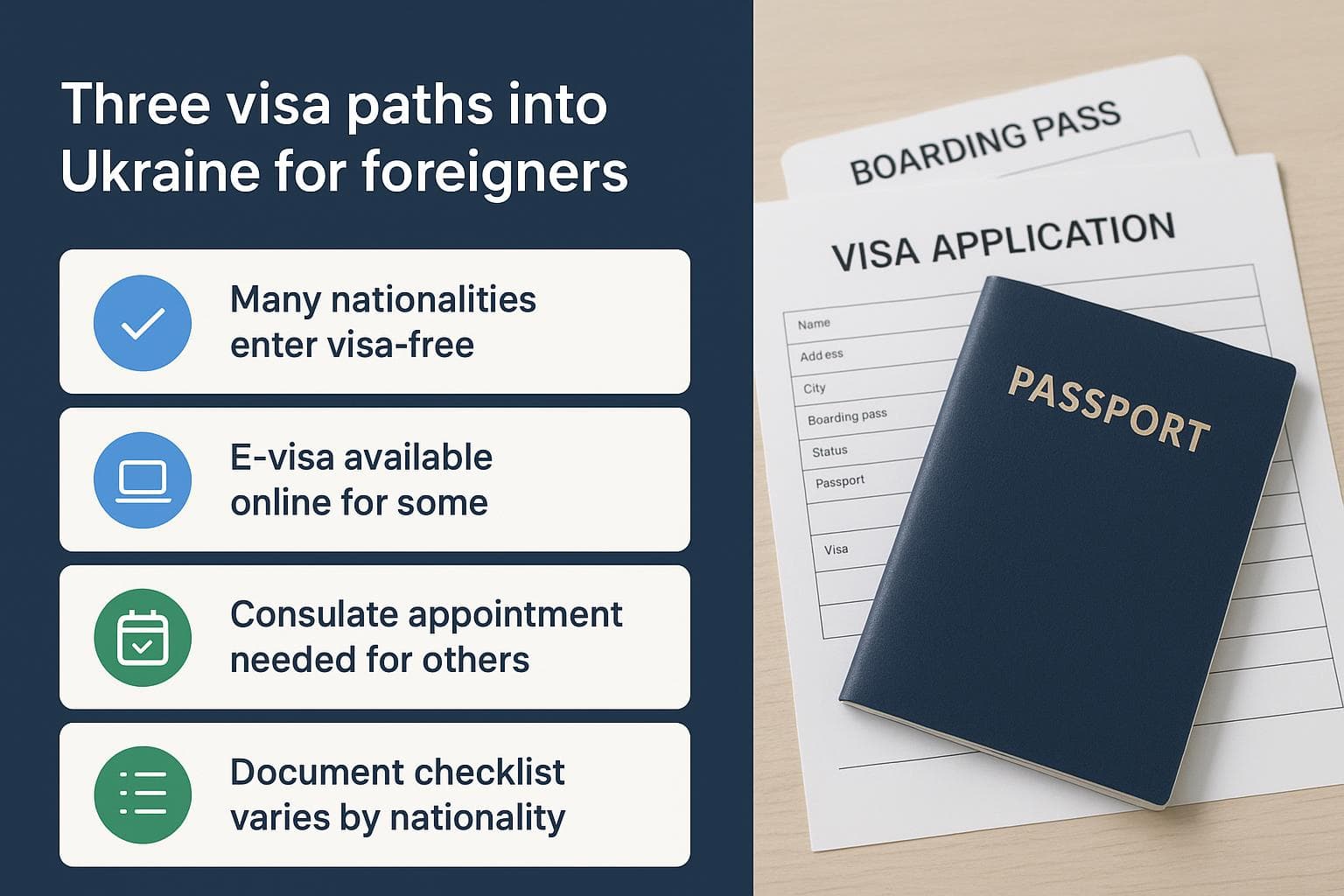
The short answer: do you need a visa
It all comes down to your citizenship. Foreign nationals fall into three clear categories:
- Visa-free entry — citizens of a number of countries may stay in Ukraine for up to 90 days within any 180-day period without any visa at all.
- Electronic visa (e-Visa) — citizens of a defined list of countries can obtain a short-stay visa entirely online, without visiting a consulate.
- Consular visa — everyone else applies at a Ukrainian diplomatic mission abroad.
One important point: the e-Visa is not available to every country. If your country is not on the e-Visa list and does not have a visa-free arrangement, online applications simply aren't an option for you — this isn't a website glitch, it's the current rule. In that case, the only viable route is the consulate (the detailed procedure is below).
The country lists for each category change over time, so always double-check directly with the official portal of Ukraine's Ministry of Foreign Affairs (mfa.gov.ua) and the e-Visa service (evisa.mfa.gov.ua) right before you start planning your trip.
Category 1: visa-free entry
If you are a citizen of an EU country, the United Kingdom, the United States, Canada, Switzerland, Japan, or a number of other states, you don't need a visa for a short trip. A valid passport is enough.
A few things to keep in mind:
- The stay limit is up to 90 days within any 180-day period. For a longer stay, work, or study, you'll need a long-stay type D visa and a residence permit.
- At the border, an officer may ask about the purpose of your trip, return tickets, where you'll be staying, and whether you have sufficient funds.
- Your passport must remain valid for the entire duration of your stay.
Visa-free entry doesn't exempt you from the other entry requirements — more on those below.
Category 2: electronic visa (e-Visa)
The electronic visa is intended for citizens of countries that don't have visa-free access but are included on the e-Visa list. It is issued for short-stay trips (tourism, business, private visits, and so on).
Here's the step-by-step process:
- Go to the official portal evisa.mfa.gov.ua (the single state-run service — steer clear of third-party intermediary sites).
- Fill in the online application and upload scans of your documents.
- Pay the consular fee online. The amount is shown on the portal itself — check there, as fees are revised from time to time.
- Wait for your application to be processed. The estimated timeframe is also stated on the official service.
- Receive your visa by email as a PDF and print it out.
The basic document package for an e-Visa:
- a passport (valid for at least the duration of the visa);
- a digital photo that meets the requirements;
- proof of the purpose of your trip (a booking, invitation, or contract);
- an insurance policy covering the entire period of your stay;
- proof of sufficient funds.
Category 3: consular visa (when online isn't available)
If your country has neither visa-free access nor e-Visa eligibility, or if you need a long-stay type D visa (for work, study, or family reunification), the application must go through a consulate.
Here's how it works in practice:
- Find your nearest Ukrainian embassy or consulate using the directory on mfa.gov.ua.
- Confirm the document list and booking procedure for your specific visa category — requirements vary from one mission to another.
- Book an appointment to submit your documents.
- Submit your application in person (some categories allow submission through a visa centre).
- Pay the consular fee at the rates set by that particular mission.
- Wait for a decision and collect your visa in your passport.
Don't rely on the timeframes and fees you see on forums — they go out of date. The only reliable information is on the page of the specific consulate.
What you need at the border regardless of visa type
A visa or visa-free status is your permission to enter, but border control also checks the supporting conditions. Have these ready:
- a valid passport;
- proof of the purpose and place of your stay;
- sufficient funds for the trip;
- a valid insurance policy covering medical expenses in Ukraine.
Insurance for entering Ukraine
Ukraine remains a country under martial law, so holding a policy with the right coverage is both a formal requirement and a practical necessity. A standard travel insurance policy often carries a "war risks" exclusion, so you need a policy that stays valid under these conditions.
You can take out a policy online in just a few minutes — on the market, products like these cost in the range of a few euros per day, and you'll see the exact amount on the quote page depending on the duration and coverage you choose.
Pay attention to the territorial exclusions. Policies of this type typically do not cover four categories of zones:
- combat zones as designated by acts of state authorities;
- temporarily occupied territories;
- a 50-kilometre buffer strip around the two categories above;
- areas under a special-access regime.
This applies to those specific zones, not to entire regions — most of the country, including major cities in the centre and west, remains within the coverage area. Plan your route to stay clear of the zones listed above.
Common mistakes to avoid
- Using intermediary sites instead of the official e-Visa portal — a risk of overpaying and of fraud.
- Relying on old rules — country lists and fees are revised, so information from 2022–2023 may no longer be accurate.
- A policy without war-risk coverage — it may not be accepted as sufficient at the border.
- Overstaying the 90-day visa-free limit — this is a violation with consequences for your future trips.