The short answer: yes, you can arrange it online — but not just any policy will do
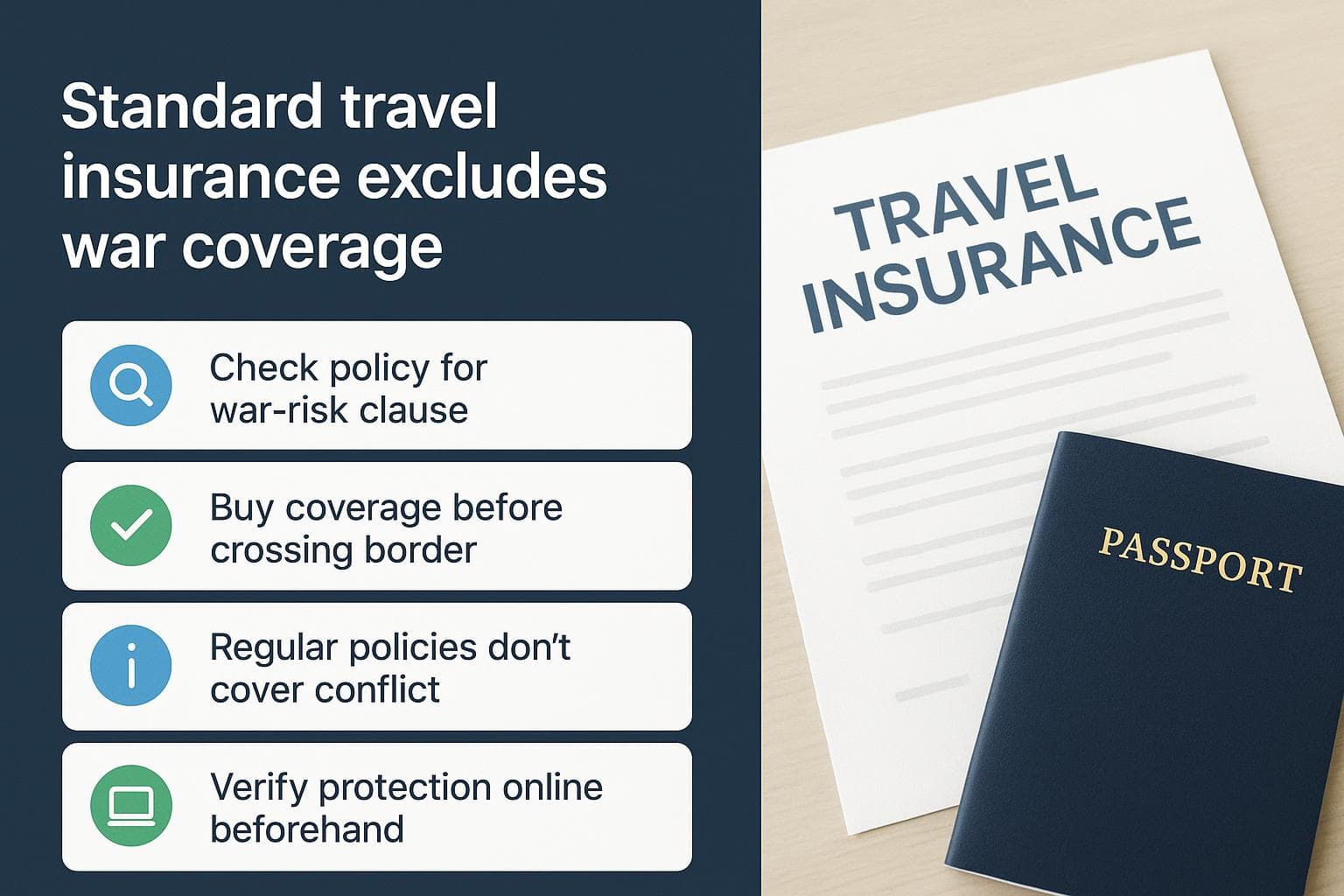
You can buy travel insurance for a trip to Ukraine entirely remotely, in a matter of minutes, before you even leave home. The issue isn't whether insurance is available — it's what the policy actually contains. The vast majority of "ordinary" travel policies sold in Europe and elsewhere include a clause excluding losses caused by war, armed conflict or hostilities. On paper you have a policy — but in the very situation you need it for in Ukraine, it won't pay out.
So the real task isn't simply to "buy insurance" — it's to buy a policy with explicitly stated war-risk cover. In the sections below we break the whole process down step by step and show you how to confirm that the cover you need is genuinely there, and not just mentioned in the marketing.
Why a standard policy usually won't work
In international insurance practice, the risks of war fall under what are known as exclusions. In plain terms, the insurer is by default not liable for injury or loss of life caused by shelling, explosions, the consequences of hostilities and so on. This approach dates back to peacetime standard wordings and is carried over into off-the-shelf products automatically.
For cover to apply in a country where an armed conflict is ongoing, the war risk has to be added back in through a specific clause in the policy. That's exactly what to look out for when choosing. If the product description makes no direct reference to cover for risks connected with combat operations, assume it isn't there — however appealing the name may sound.
Step 1. Set out the basic details of your trip
Before moving on to a quote, have these ready:
- entry and exit dates — the policy should cover your entire stay, ideally with a small buffer in case of delays;
- your nationality and travel document (your passport);
- your route and destination city — this matters for checking the territorial exclusions (see Step 3);
- the medical cover amount you want — base it on the real cost of treatment and possible evacuation.
You'll need this information on the quote page, and it also helps you judge for yourself whether a policy fits your situation.
Step 2. Confirm the policy includes war-risk cover
This is the pivotal step of the whole process. Before paying, make sure that:
- the list of covers explicitly names risks connected with armed conflict and combat operations;
- a specific sum insured is stated for that particular cover;
- the terms are available to read before purchase, not buried "somewhere in the contract after you've paid".
If the seller dodges a straight answer to "Does this policy cover the consequences of combat operations in Ukraine?", that's your cue to look elsewhere. A trustworthy option always lets you read the key terms in advance.
You can run a quote and see the exact scope of cover on the policy selection page — there your trip details are turned straight into concrete terms, with no hidden caveats.
Step 3. Understand the territorial exclusions (this is not "entire regions")
Even a policy with war-risk cover doesn't apply absolutely everywhere — and that's normal and lawful. What matters is that a properly designed product defines its exclusions not by "regions on a map" but by four categories of zone:
- active combat zones — as designated by the state acts that define such areas;
- temporarily occupied territories;
- a 50-kilometre buffer strip around both of the above categories;
- areas under a special-access regime.
In other words, cover applies across the rest of the country, with exclusions tied to officially designated zones rather than to the administrative borders of whole regions. When planning your route, check your destination against these categories — that way you'll know exactly where the policy works.
Step 4. Arrange and pay for the policy online
The purchase itself is straightforward:
- enter your trip details on the quote page;
- choose the option with war-risk cover and the sum insured you want;
- fill in the insured person's details exactly as they appear in the passport;
- pay by card;
- receive your electronic policy by email.
On the market, this type of insurance typically works out to a few euros per day of stay, depending on the length of the trip, the traveller's age and the sum insured chosen. You'll see the exact figure on the quote page — we deliberately don't quote fixed prices here, because they're calculated individually.
Save the policy both as a file on your phone and as a printout — at the border and at a hospital, a paper copy can sometimes be more convenient.
Step 5. What to have with you at the border
For entry, have ready:
- a valid passport and, if required, a visa;
- your electronic or printed insurance policy, showing the period of cover and what's included;
- assistance contacts (the insurer's 24/7 help line);
- confirmation of the purpose and route of your trip, if asked for it.
Current document requirements for crossing the border should be checked against official sources: the State Border Guard Service of Ukraine and the Ministry of Foreign Affairs of Ukraine. Rules can be refined, so check them directly before you travel rather than relying on articles alone.
How to be sure the insurer and the seller are reliable
Before buying, it's worth looking at the regulatory backing of the product:
- the insurer operates under the supervision of the National Bank of Ukraine and holds a licence under class 18 (travel insurance);
- it is part of a group listed on an EU exchange and operating under the solvency requirements of the Solvency II directive;
- the agent offering the policy is identified by USREOU code 44559356;
- in line with the insurance distribution rules (IDD), the seller must disclose its role and status before the contract is concluded.
These markers help you tell a genuine, regulated product apart from dubious "certificates" that have no real legal backing.
In summary
Buying insurance for a trip to Ukraine isn't about hunting for the cheapest policy — it's about verifying one specific thing: whether it includes explicit war-risk cover and whether the territorial exclusions are correctly described using the four categories of zone. If those conditions are met, arranging it takes a few minutes online, and at the border you simply need your passport and your policy. Everything else — the sum insured, the exact price and the full terms — should always be checked on the quote page and against official sources before you set off.