In brief: how people enter Ukraine right now
As of 2026, Ukrainian airspace remains closed to civilian aviation under martial law. In plain terms, that means one thing: you cannot fly directly into Kyiv, Lviv or Odesa. If you've been searching for a flight, the answer is "no" — and this isn't a temporary delay on one particular route, but a system-wide restriction.
The workable option for a foreigner today is overland: you fly into a neighbouring EU country (most often Poland, Slovakia, Hungary or Romania) or into Moldova, then cross the border by car, bus, train or on foot at an appropriate crossing point. Below is how to do it step by step, with no surprises at the border.
Step 1. Choose your land border direction
All operating civilian crossing points for foreigners are on the western border. Here's how to think about the choice by neighbouring country:
- Poland — the busiest direction, with the most crossing points and convenient rail links (for example, Przemyśl — Lviv — Kyiv). A good fit if you're flying into Warsaw, Kraków or Rzeszów.
- Slovakia — a compact border with often shorter queues, convenient from the Košice side. Leads into the Zakarpattia region (Uzhhorod).
- Hungary — leads into Zakarpattia, with rail and bus connections to Chop and beyond.
- Romania — relevant for the south and for travellers coming from the Suceava or Iași side; there are both road and pedestrian crossings.
- Moldova — a workable route for southern and central Ukraine; keep in mind that part of the Moldova–Ukraine border runs through Transnistria — that stretch is not suitable for transit, so use crossing points on the section controlled by the government of Moldova.
Important: routes across the eastern and northern borders, and through temporarily occupied territories, are not available for entry. Plan for the western direction only.
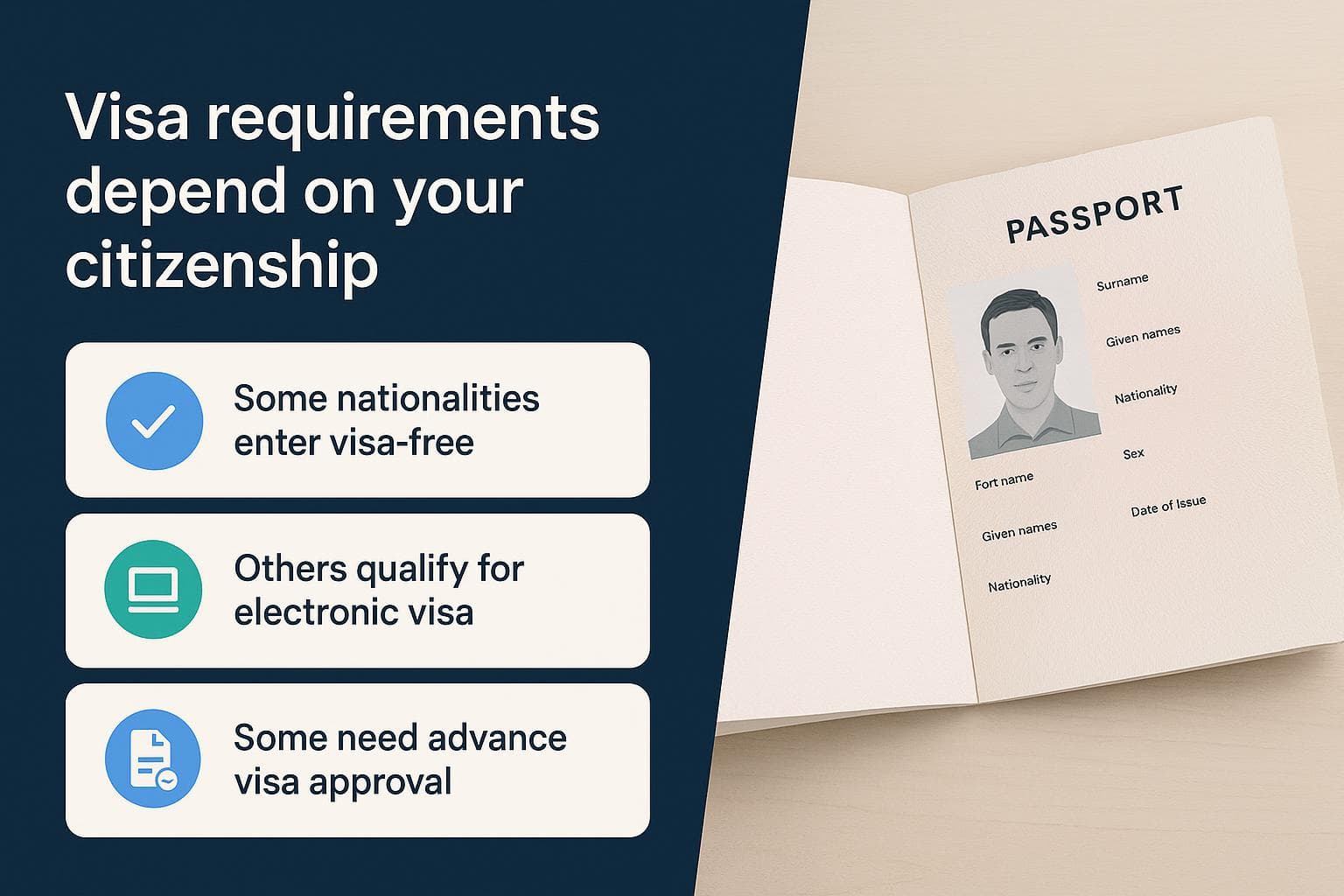
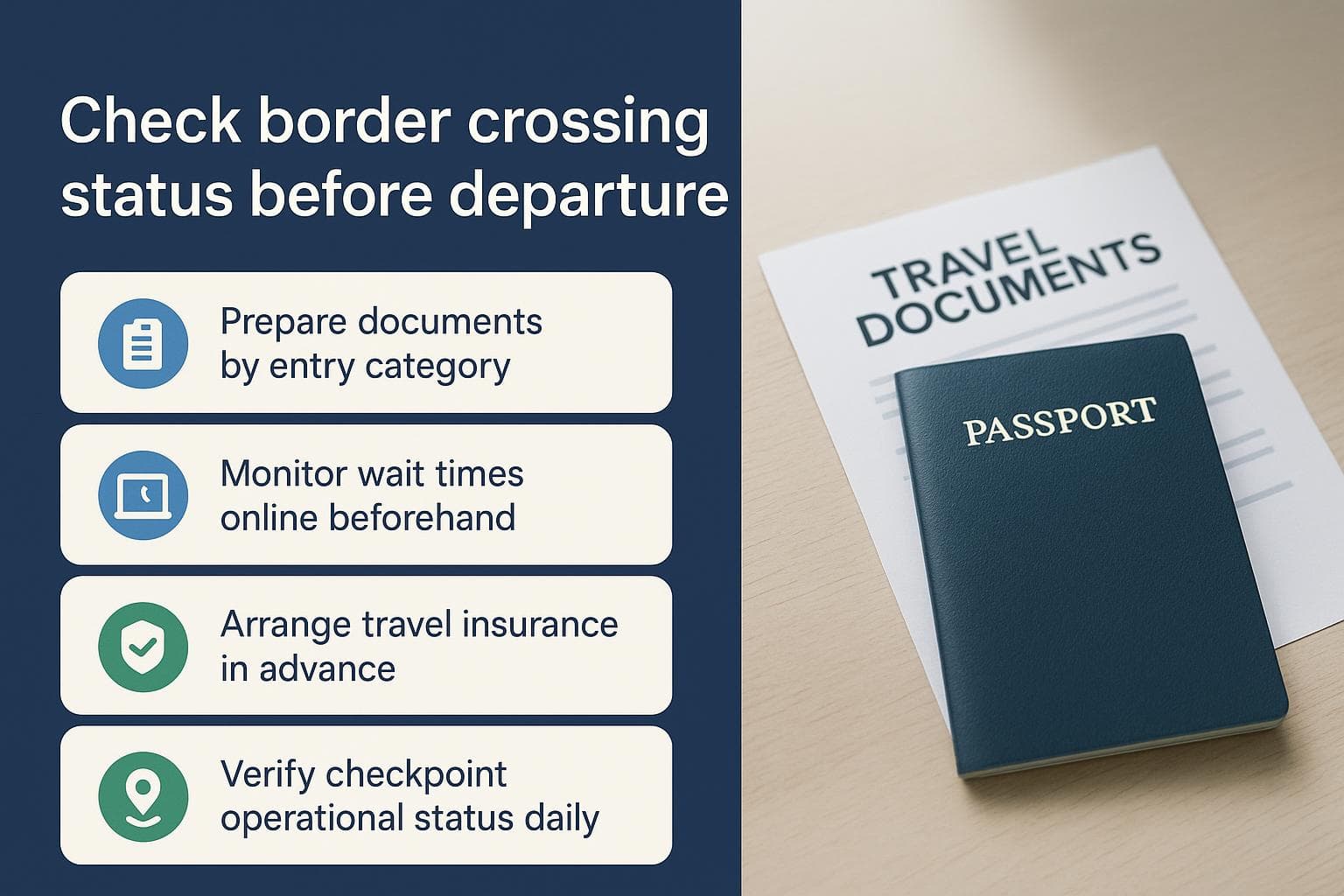
Step 2. Prepare your documents by entry category
What you need depends on the category under which you're entering. Let's go through the main ones.
Visa-free travellers (citizens of the EU, US, UK, Canada and other visa-free countries)
- A passport valid for your entire stay.
- Proof of the purpose and duration of your trip (bookings, return tickets) — border officers may ask for these.
- Sufficient funds for the duration of your stay.
- An insurance policy covering your stay in Ukraine (see the dedicated section below).
The visa-free stay is up to 90 days within any 180-day period.
Foreigners who need a visa
- A valid Ukrainian visa (of the type matching your purpose — B, C, D and so on).
- A passport.
- Documents substantiating the purpose of your trip (invitation, contract, proof of study/work).
- An insurance policy.
To check whether you need a visa and to apply, use only the official portal of Ukraine's Ministry of Foreign Affairs — VisaWiz (evisa.mfa.gov.ua). Avoid intermediaries who promise "fast-tracking".
Those entering for a long stay or residence
- A long-term type D visa (if required).
- Documents to obtain a temporary or permanent residence permit after entry.
- Supporting documents for the grounds of your stay (employment, family reunification, study).
Drivers of privately owned vehicles
- The vehicle registration certificate.
- A valid Green Card (international motor insurance) valid in Ukraine, or a policy purchased at the border.
- A customs declaration for temporary vehicle importation — completed at the border; check the current rules and duty-free periods for vehicles on the website of the State Customs Service (customs.gov.ua).
Step 3. Check the crossing-point status and wait time online
Queues at the western border change daily. Before heading to a specific checkpoint, check two official sources:
- The State Border Guard Service of Ukraine (dpsu.gov.ua) — publishes the list of operating crossing points and their status. You can also see whether a crossing is running normally.
- The State Customs Service border queue tracker — shows an approximate number of vehicles and wait times for specific directions, close to real time.
A practical tip: pedestrian and rail crossings are usually more predictable than road ones on peak days (weekends, holidays). If you travel by bus or train, the queuing time is already built into the carrier's schedule.
Step 4. Passing through control: how it works in practice
- Exit control on the neighbouring country's side — a passport check on the EU/Moldova side.
- Ukrainian border control — an officer checks your passport, your visa if required, stamps your entry, and may ask clarifying questions about the purpose and length of your trip.
- Customs control — declaring goods, cash above the set limits, and vehicles. Check the limits for importing cash and goods on the State Customs Service website before your trip.
- Receiving your entry stamp — keep the stamped passport, as you'll need it when leaving and to confirm the lawfulness of your stay.
Allow extra time: during peak periods, clearing a road checkpoint can take several hours or more.
War-risk insurance: why it's not a formality
A standard travel policy bought "for the Schengen area" almost always does not cover events related to warfare. For a trip to Ukraine under martial law, you need a policy that specifically includes war risks — otherwise, in a critical situation, you'll be left without cover.
It's best to arrange such a policy before crossing the border, calmly rather than in a rush at the checkpoint. You can calculate the cost and set up cover online in a few minutes — get a policy with war-risk insurance. Market prices for this kind of cover start from a few euros per day — you'll see the exact figure on the quote page, depending on the duration and terms.
Pay attention to the territorial exclusions. Policies do not apply in four categories of zones:
- areas of active combat as defined by the relevant state acts;
- temporarily occupied territories;
- a buffer zone of roughly 50 km around the first two categories;
- areas under a special-access regime.
This does not mean "entire oblasts" — the exclusion applies specifically to these zones. The rest of the country, the safer part where most travellers are headed, is covered. Before your trip, cross-check your route against these limits.
Common mistakes that cost you time at the border
- Arriving at a checkpoint without first checking its status — it may be operating on a limited basis.
- Counting on a direct flight into Ukraine — there isn't one.
- Travel insurance with no war-risk cover.
- Trying to enter via Transnistria instead of the section of the border controlled by the government of Moldova.
- Not having return tickets or proof of purpose when an officer asks for them.
Official sources to open before your trip
- State Border Guard Service of Ukraine — dpsu.gov.ua (list and status of crossing points).
- State Customs Service — customs.gov.ua (queues, limits, importing vehicles and cash).
- Ukraine's MFA visa portal — evisa.mfa.gov.ua (whether you need a visa and how to apply).
Rely on these alone: rules under martial law can be updated, and it's the official resources that reflect the current picture.