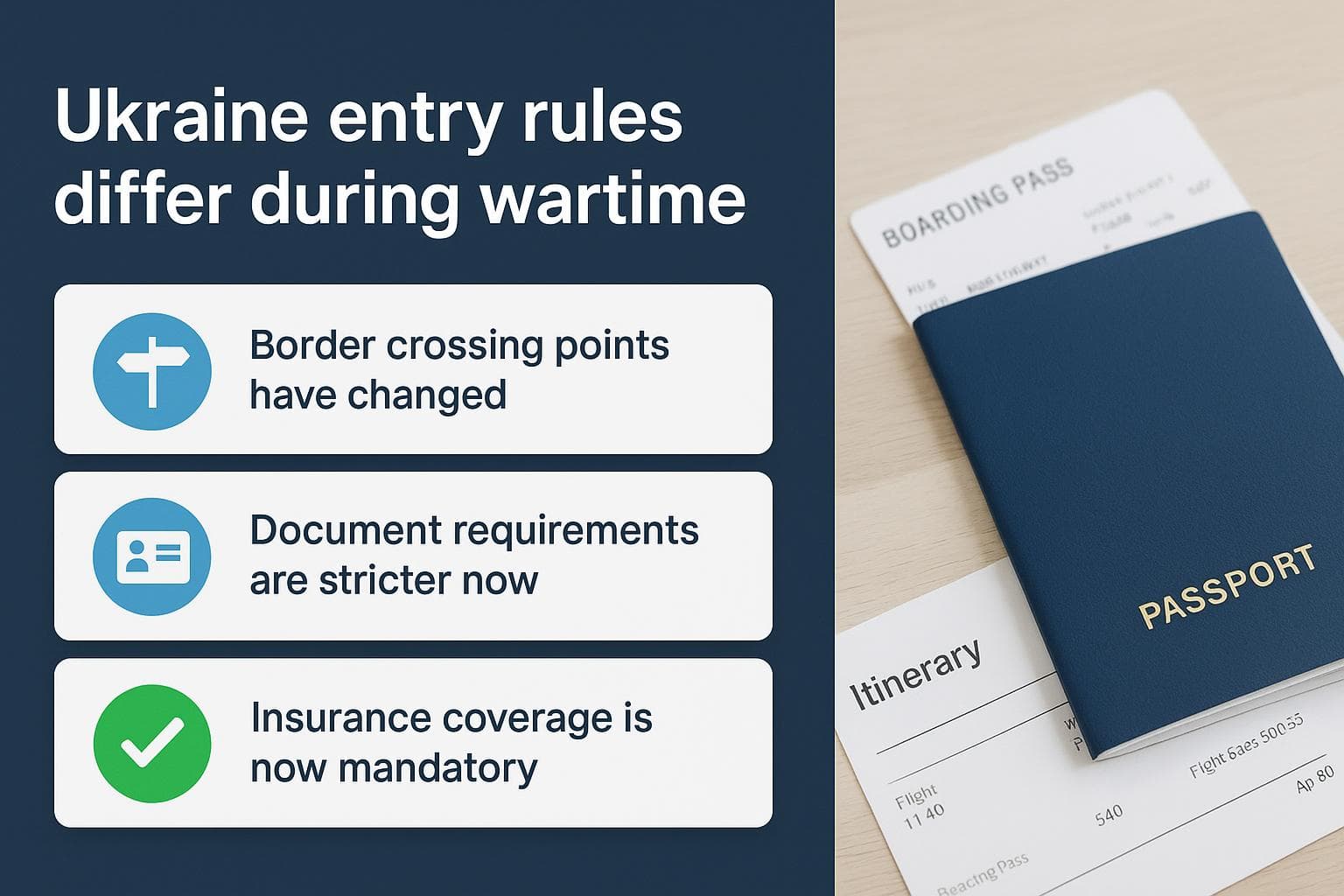
Can you actually enter Ukraine in 2026?
Yes. Despite martial law being in effect, Ukraine has not closed its border to foreign nationals. Tourists, business travellers, volunteers, journalists, and relatives of Ukrainian citizens continue to arrive every day. That said, there is one key thing to understand: Ukrainian airspace is closed to civil aviation, so international airports are not operating. Entry is possible only by land — through land border crossings with neighbouring EU countries and Moldova.
This reshapes your entire travel logistics: you fly into a neighbouring country (most often Poland, Romania, Hungary, Slovakia, or Moldova) and then continue to the border by car, bus, or train.
The essential document list for all foreigners
Whatever your reason for visiting, every foreigner must carry the following at the border:
- A valid international passport that stays valid for your entire stay.
- Grounds for entry — visa-free travel, a visa, or a residence permit (depending on your citizenship; more on this below).
- Documents confirming the purpose of your trip — accommodation bookings, an invitation, return tickets, and so on.
- Proof of sufficient funds for the duration of your stay.
- A medical insurance policy valid within Ukraine (a mandatory requirement — covered separately below).
The current list of documents for crossing the border is published by the State Border Guard Service of Ukraine (SBGS) on its official website, dpsu.gov.ua. Confirm visa requirements for your country on the portal of the Ministry of Foreign Affairs of Ukraine (mfa.gov.ua) and in the "VisitUkraine" section.
Requirements by visitor category
The rules depend on your citizenship and the purpose of your visit. Below is a general breakdown; for your specific country, always check with the Ministry of Foreign Affairs.
Citizens of visa-free countries (EU, USA, Canada, UK, etc.)
May stay in Ukraine for up to 90 days within a 180-day period without a visa. You will need: a passport, an insurance policy, and proof of purpose and funds. No visa is issued, but a border officer may ask you to explain the purpose of your trip.
Citizens of countries requiring a visa
A visa is required, arranged in advance at a Ukrainian consular office or through the electronic visa system (where this option is available for your country). The visa type (short-stay C or long-stay D) depends on the purpose and duration. The list of countries and the procedure are on the Ministry of Foreign Affairs website.
Volunteers and humanitarian workers
You will need an invitation from an organisation, documents confirming the nature of your work, and, depending on your citizenship, the appropriate visa. Given the security situation, we recommend having a detailed travel plan and avoiding high-risk destinations.
Journalists
Accreditation is required. Foreign media workers must obtain a media representative's credential issued by the authorised body; without it, working in frontline areas is impossible and dangerous.
People reuniting with family
You will need documents proving your family relationship with a Ukrainian citizen or a person with legal residence status.
Registration after entry
As a general rule, foreigners who enter for a short stay under visa-free travel or a short-stay visa usually do not need separate registration with the migration authorities — an entry stamp is placed at the border. However, if you plan to stay beyond your permitted visa-free period or are applying for a temporary or permanent residence permit, contact the State Migration Service (SMS) at your place of stay. Overstaying your permitted period leads to fines and an entry ban, so keep an eye on your dates.
The current rules on registration and extending a stay are on the State Migration Service website (dmsu.gov.ua).
Insurance: a mandatory condition for entry
Medical insurance valid within Ukraine is a formal requirement for entry, and a border officer has the right to ask to see your policy. But under martial law, an ordinary travel policy is not enough: most standard plans do not cover risks related to military action. This is exactly why foreigners travelling to Ukraine in 2026 need insurance that covers war-related risks.
On the market, such a policy usually costs a few euros per day and depends on the length of your stay and the extent of coverage — you will see the exact amount when you get a policy quote.
Pay attention to the territorial exclusions found in any honest policy. Coverage generally does not apply in four categories of zones:
- Combat zones — as defined by the relevant state acts.
- Temporarily occupied territories.
- A 50-kilometre buffer zone around the first two categories.
- Areas with a special-access regime.
Important: the exclusions apply specifically to these zones, not to entire oblasts. In other words, safe areas — even in regions bordering a combat zone — may remain covered. Plan your route to stay out of the excluded zones; otherwise, your insurance protection will not apply there.
Which border crossings are operating in 2026
Entry is via land border crossings on the western and south-western border. The main directions are:
- With Poland — the busiest direction; several vehicle and pedestrian crossings, plus rail connections.
- With Slovakia, Hungary, and Romania — road and rail crossings.
- With Moldova — road crossings.
The border with Belarus and Russia is closed to entry for security reasons.
The list of operating crossings and their status can change, so before you travel, always check the latest information on the SBGS website and in the eCherha (eQueue) queue-monitoring app/service for cargo and passenger vehicles.
How long does it take to cross the border?
Waiting times vary enormously — from a few hours to a full day or more during peak periods. Duration is affected by: the crossing you choose, the day of the week, the time of day, your mode of travel (on foot is often faster than by car), and the overall security situation. Crossing on foot at popular Polish checkpoints is frequently quicker than crossing by car.
Check live queues in real time in the eCherha (eQueue) service and on the official SBGS resources.
Where to check the rules right before your trip
Under martial law, the rules can change quickly. A few days before you travel, verify against the primary sources:
- SBGS (dpsu.gov.ua) — documents for crossing, status of border crossings.
- Ministry of Foreign Affairs of Ukraine (mfa.gov.ua) — visa requirements by citizenship.
- State Migration Service of Ukraine (dmsu.gov.ua) — registration and extending a stay.
- Cabinet of Ministers of Ukraine (kmu.gov.ua) — the resolutions governing entry during martial law.
- eCherha (eQueue) — border queues in real time.
Prepare your documents in advance, arrange insurance with war-risk coverage, and plan your route around the excluded zones — that is the best way to avoid problems at the border.