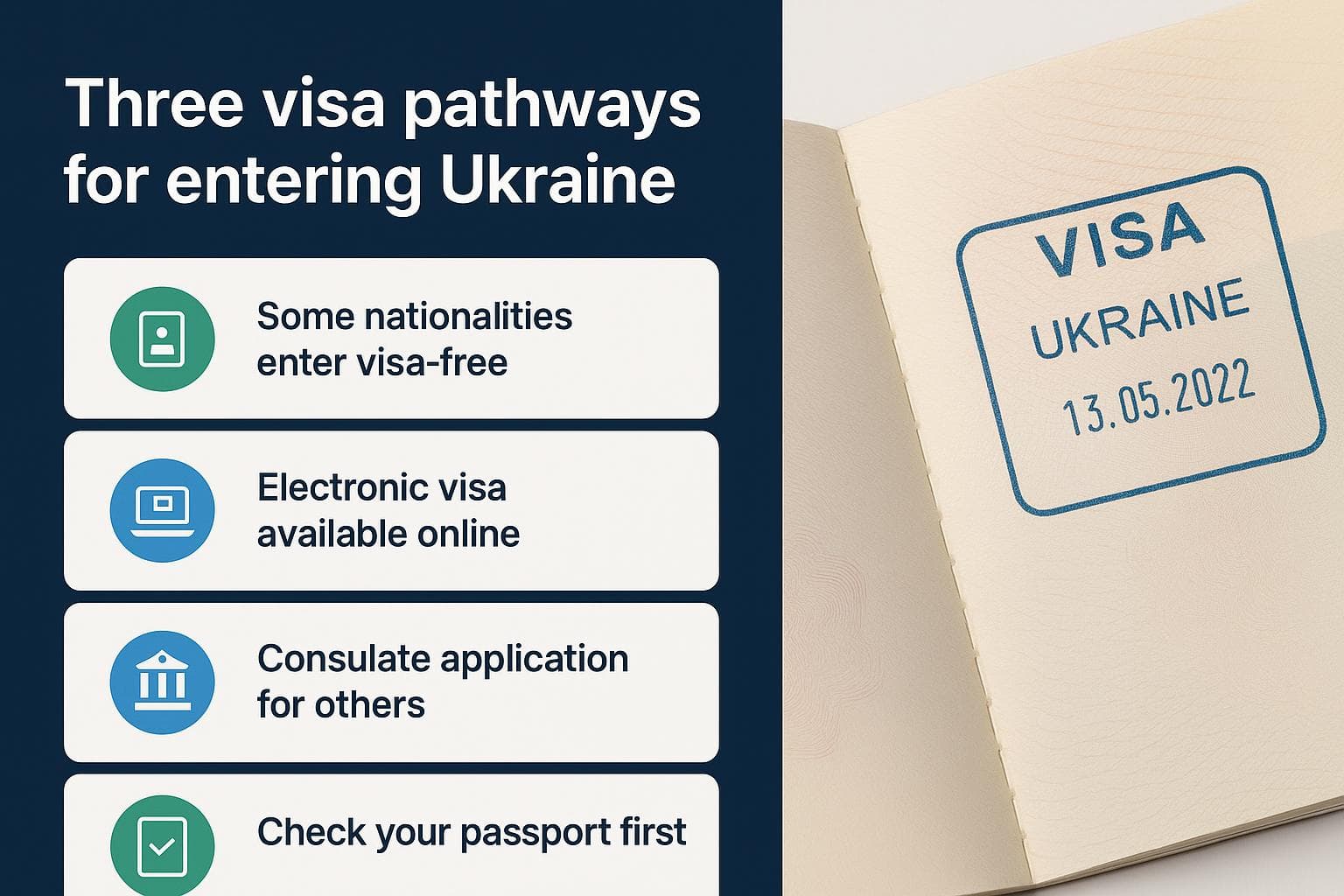
The short answer: three entry regimes
Entry into Ukraine in 2026 falls under one of three scenarios, and your citizenship determines which one applies to you:
- Visa-free entry — for citizens of the EU, most European countries, and a number of other states. No visa is required at all.
- Electronic visa (e-Visa) — for citizens of certain countries, who apply online and receive authorization without visiting a consulate.
- Consular visa — for everyone else; the visa is issued in person at a Ukrainian diplomatic mission abroad.
One important point: none of these categories applies to citizens of the Russian Federation — for them, entry follows a special permit procedure set out in separate legal acts, and it falls outside the scope of this article.
The country lists change over time, so the only reliable source is the official portal of Ukraine's Ministry of Foreign Affairs, visa.mfa.gov.ua. Below, we explain how to figure out which group you belong to.
Who enters without a visa
The visa-free regime applies to citizens of European Union member states, as well as the United Kingdom, the United States, Canada, Switzerland, Norway, Iceland, Japan, South Korea, Australia, and a number of other countries. The permitted visa-free stay is usually up to 90 days within any 180-day period, although some countries are subject to different terms.
Even under visa-free entry, you need to have the following with you at the border:
- a passport valid for the entire duration of your trip;
- proof of the purpose of your visit (accommodation booking, invitation, return ticket);
- proof of sufficient funds;
- a valid medical insurance policy — a separate requirement covered below.
Visa-free means no visa is needed, but it does not guarantee automatic entry: the final decision rests with a State Border Guard Service officer. You can check your country's status in the visa requirements section of the MFA website.
Who needs an electronic visa (e-Visa)
The electronic visa is a middle-ground option for citizens of countries that don't have visa-free access but are eligible for a simplified online procedure. You apply through the official portal evisa.mfa.gov.ua without visiting a consulate.
Here is the step-by-step process:
- Register on the official e-Visa portal of Ukraine's MFA.
- Complete the application form — personal details, purpose, and dates of your trip.
- Upload your documents: a scan of your passport, a photo, proof of the purpose of your visit (booking, invitation), an insurance policy, and proof of finances.
- Pay the consular fee online. Check the fee amount directly on the portal — the figures are revised periodically, so rely only on the official number, not on third-party sites.
- Wait for a decision. The standard processing time is stated on the portal; expedited handling may be available in certain cases.
- Print your visa and bring it with you — you may be asked for a paper copy at the border.
The electronic visa is usually issued as a short-stay (type C) visa for tourism, business, or transit. For work, study, or family reunification, you need a consular visa.
Who needs a consular visa
If your country is on neither the visa-free list nor the e-Visa list, or if your trip is long-term (work, study, permanent residence), you will need to apply for a visa in person at a Ukrainian diplomatic mission.
The general procedure is as follows:
- Find the nearest Ukrainian embassy or consulate on the MFA website.
- Complete the online application form through the visa portal and print it out.
- Book an appointment according to the rules of the specific mission.
- Prepare your document package: passport, photo, application form, proof of purpose, insurance policy, proof of finances, and — for long-stay (type D) visas — additional documents depending on the grounds (an employer's invitation, a certificate from an educational institution, etc.).
- Pay the fee and submit your documents in person.
- Receive a decision within the timeframe set by the consulate.
Since requirements vary between missions and visa types, always confirm the final document list directly on the page of the specific embassy.
If you're a citizen of a country with no visa route available
Sometimes a citizen of a particular state has access to neither visa-free entry nor an e-Visa, and the nearest Ukrainian consulate is closed or not operating due to the security situation. This is not a dead end — here's what works:
- Contact a Ukrainian consulate in a neighboring third country that accepts applicants from your state (the list of accredited missions is on the MFA website).
- Ask about the option of applying through a visa center or a remote consultation.
- For humanitarian or exceptional cases, contact the MFA's consular department directly.
The golden rule: don't rely on intermediaries who promise a "guaranteed visa" — the decision is always made solely by the official mission.
Insurance: a mandatory condition of entry
Whether you enter visa-free, on an e-Visa, or on a consular visa, a valid medical insurance policy is a requirement that a border officer may check. But under martial law, an ordinary travel policy is often not enough: most standard programs don't cover risks related to combat operations.
That's why, for a trip to Ukraine, you should choose a policy that includes war-risk coverage. You can arrange one online in just a few minutes — you can calculate the cost and buy a policy in advance, before you travel. On the market, such policies cost in the range of a few euros per day; the exact price depends on the duration and terms, and it's always shown on the quote page.
Pay attention to the territorial exclusions — even policies with war-risk coverage usually do not apply in four categories of zones:
- areas of active combat operations as designated by acts of state authorities;
- temporarily occupied territories;
- a 50-kilometer buffer zone around both of the above;
- territories under a special-access regime.
This means the insurance covers travel through safer regions but not the combat zone. Plan your route with these limits in mind and check the current list of zones before you set off.
What to check before your trip: the final checklist
- Determine your entry regime on the official portal visa.mfa.gov.ua.
- Make sure your passport is valid for the entire duration of your trip.
- Prepare proof of the purpose of your visit and of your finances.
- Arrange an insurance policy with war-risk coverage.
- For an e-Visa, print out the visa; for a consular visa, check the requirements of the specific mission.
- Check the current status of border crossing points on the State Border Guard Service website.