Short answer: yes, but not by plane
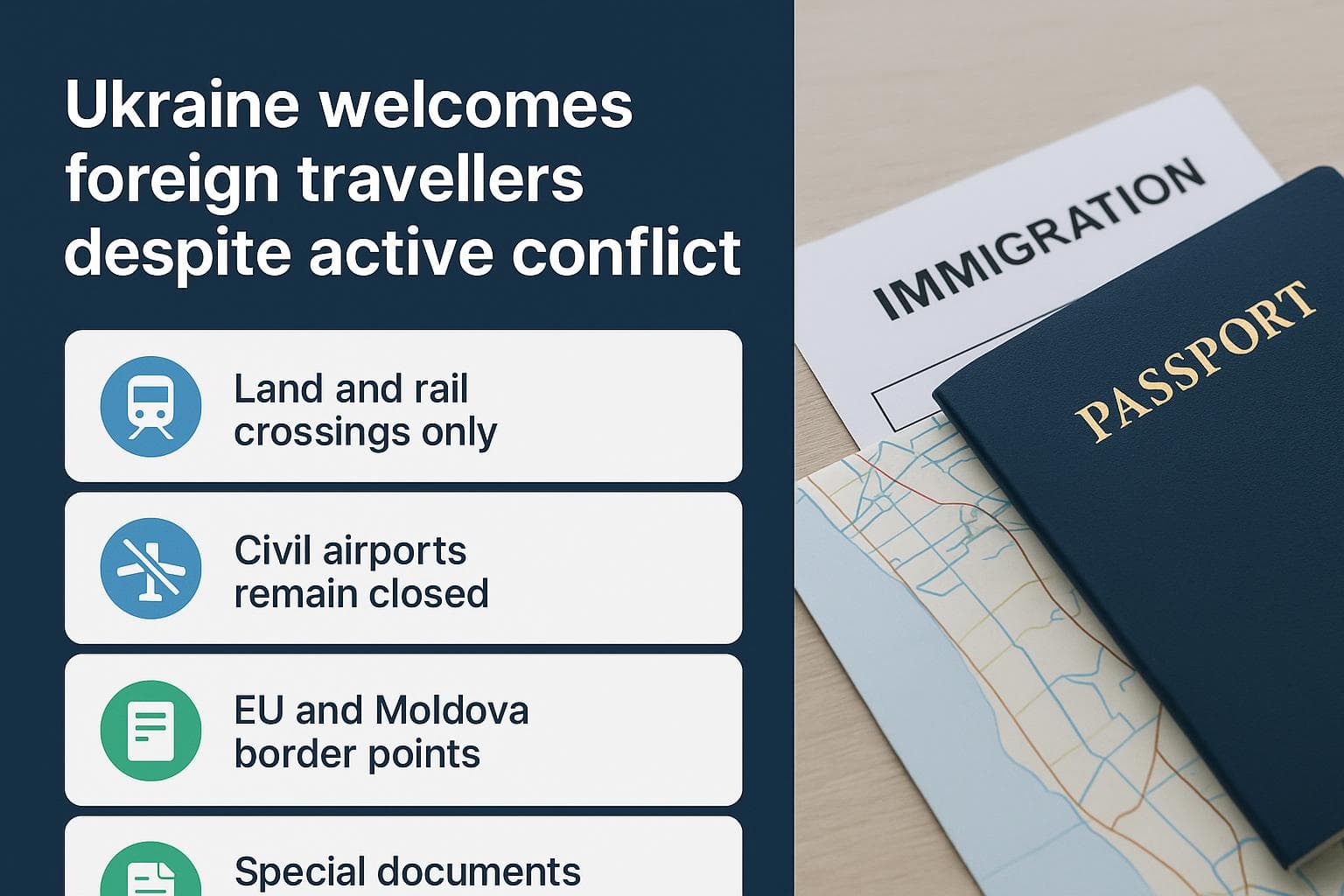
As of 2026, Ukraine remains open to foreign nationals. The border is operating, and tourists, journalists, volunteers, and business travelers cross every day. There's just one difference from peacetime, but it's a decisive one: civilian air travel is suspended. Because of martial law, Ukrainian airspace is closed to commercial flights, so flying directly into Kyiv, Lviv, or Odesa isn't possible.
This doesn't mean "entry is banned." It means you get there differently — overland, through one of the neighboring European Union countries or through Moldova. That route is entirely legal and well established.
Why the airports are closed
Ukrainian airspace has been closed since February 2022 by a decision of the aviation authorities due to the war. This applies to every civilian airport without exception. Any offer of "direct flights to Ukraine" in 2026 is a sign of a scam. You can check the current status of the airspace on the official resources of the State Aviation Administration of Ukraine.
The takeaway for planning: buy your ticket to an airport in a neighboring country, then cover the last leg overland.
The working route: through neighboring EU countries and Moldova
Here's the most common travel logic for someone coming from Japan or another distant country:
- Fly to a hub near Ukraine. The most convenient airports are Warsaw, Krakow, and Rzeszow (Poland), Budapest (Hungary), Bucharest (Romania), Chisinau (Moldova), and Bratislava (Slovakia).
- Cover the overland leg to the border. From there, take a train, an international bus, or a transfer to the crossing point.
- Cross the border. On foot, by car, or by international train. For example, direct trains run from Lviv and Kyiv to Poland, Hungary, Austria, and Moldova.
The most popular entry point is through Poland (crossings heading toward Lviv). The up-to-date list of open crossing points and their traffic load is published by the State Border Guard Service of Ukraine — this is the primary source to check before you set off, since operating conditions can change.
Visa rules and length of stay
Whether you need a visa depends on your nationality — and martial law has mostly left this unchanged. Citizens of many countries, including Japan, the EU, and the US, can enter visa-free for short stays (typically up to 90 days within any 180-day period). Verify the exact terms for your passport on the website of the Ministry of Foreign Affairs of Ukraine — this is the official and only reliable source on visas.
A mandatory document is a passport valid for the entire duration of your trip. A visa, if you need one, must be obtained in advance at a consular office.
Document checklist for crossing the border in 2026
- A valid passport.
- A visa — if your nationality requires one (check the Ministry of Foreign Affairs website).
- Proof of the purpose and route of your trip (accommodation bookings, return tickets) — a border officer may ask for it.
- Sufficient funds for the length of your stay.
- An insurance policy with coverage for the martial law zone — more on this below.
- If applicable — contact details for your host, an invitation, or professional accreditation (for journalists and volunteers).
Customs rules on bringing in cash, personal belongings, and declaration procedures apply as usual; check the limits and declaration form on the website of the State Customs Service of Ukraine.
On martial law: what's important to understand
Ukraine is under the legal regime of martial law. For a foreign traveler, this has several practical implications:
- Curfew. Many regions have a nighttime movement ban; the hours vary by region. Plan to travel during daylight.
- Air raid alerts. When the signal sounds, you need to go to a shelter. Install the official alert app, Air Alert.
- Restricted zones. Approaching combat areas, occupied territories, and military sites is prohibited and dangerous.
Responsibility for your own safety rests with you as the traveler. Assess the risks soberly and follow the guidance of your own foreign ministry.
Insurance: why an ordinary policy isn't enough
Standard travel policies usually do not cover events related to military action — which are exactly the risks most relevant on a trip to Ukraine. That's why you need a separate policy that accounts for martial law risks. On the market, such policies cost in the range of a few euros per day — you'll see the exact price for your dates and route once you get a policy quote here.
Pay attention to the territorial exclusions written into most of these policies. Coverage typically does not apply in four categories of zones:
- areas of active combat as defined by state acts;
- temporarily occupied territories;
- a buffer zone of roughly 50 km around the first two categories;
- territories with a special-access regime.
The rest of the country is generally covered. Read the terms of your specific policy carefully before buying.
Where to look before you leave
- State Border Guard Service of Ukraine — open crossing points, queues, operating hours.
- Ministry of Foreign Affairs of Ukraine — visa rules by nationality.
- State Aviation Administration — airspace status.
- State Customs Service — customs limits and declarations.
- Your own country's foreign ministry — travel advisories for citizens.
Check these sources a few days before departure: under martial law, details change faster than any guidebook can keep up.